Table of Contents
Introduction
What is a Divestiture?
Divestiture vs. Divestment vs. Disinvestment vs. Liquidation
Why Companies Pull the Trigger on Divestitures
The Main Types of Divestitures
The Ripple Effect
The Real-World Challenges of Divesting
Best Practices
Where Technology Changes the Game
Case Studies
The Future of Divestitures in M&A
Final Take: Sharpening Your Business Edge
1. Introduction: Why Divestitures Are Back in the Spotlight
The M&A world loves a flashy acquisition. But while the media chases headlines, the real action is often on the other side of the deal table. Divestitures are the quiet power moves reshaping industries.
When a company sheds a division, it’s not always desperation. Sometimes it’s precision. Think of IBM spinning off Kyndryl in 2021 or Johnson & Johnson breaking into two businesses. These weren’t failures. They were bets that focus beats bloat.
And here’s the kicker: the number of corporate carve-outs has been climbing. In today’s markets, divestitures aren’t rare exceptions. They’re part of the strategy toolkit — and if you’re not ready to handle them, you’re already behind.
2. What is a Divestiture?
A divestiture is the deliberate sale, spin-off, or shutdown of part of a company. The motivation can be financial, strategic, or regulatory — but the outcome is the same: you’re trimming the business down to sharpen its edge.

One way to picture it is like a Formula 1 pit crew. Sometimes you add fuel (acquisitions), sometimes you swap out the tires (restructuring), and sometimes you strip off weight to gain speed (divestitures). Each move is about getting across the finish line faster.
3. Divestiture vs. Divestment vs. Disinvestment vs. Liquidation

Bottom line: a divestiture is a choice. A liquidation is usually forced. One signals control; the other signals survival mode.
4. Why Companies Pull the Trigger on Divestitures
Not every divestiture has a dramatic backstory. Some are boringly practical — like when a conglomerate trims a business that no longer fits. Others are sparked by market pressure.
Take General Electric. For decades it was the poster child for sprawling empires. But over time, complexity killed performance. GE’s string of divestitures — appliances, finance, healthcare — was about one thing: focus.
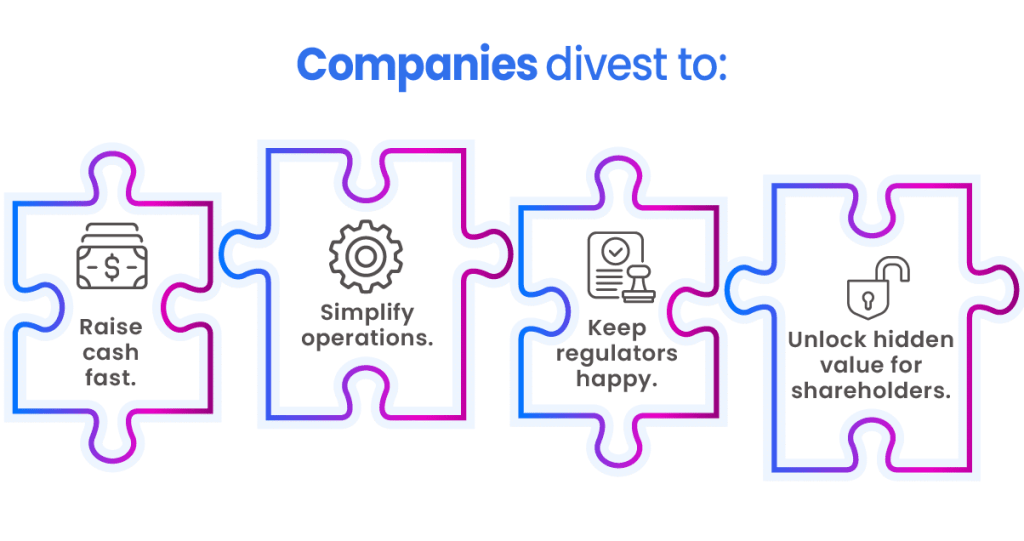
Companies divest to:
- Raise cash fast.
- Simplify operations.
- Keep regulators happy.
- Unlock hidden value for shareholders.
Sometimes it’s offense, sometimes defense. Either way, divestitures are rarely accidents.
5. The Main Types of Divestitures (and How They Play Out)
Not all divestitures are created equal.
A sell-off is the simplest. You sell a business line, take the money, move on. Clean break.
A spin-off is trickier: you create a new company and hand it to shareholders. Done right, both sides get to thrive independently.
Carve-outs and split-ups add complexity, especially when public markets or partial stakes are involved.
Here’s the catch: the type of divestiture you choose isn’t just a legal formality. It shapes valuation, tax exposure, and how investors react. A spin-off might preserve long-term upside. A sell-off might deliver quick liquidity but no future stake. Strategy matters.
6. The Ripple Effect: How Divestitures Impact Valuation and Deal Structure
Pulling one piece out of a company changes the whole puzzle. Buyers want a clean, standalone business with clear numbers. Sellers want maximum value. Between those goals sit tax structuring, transitional service agreements, and a lot of negotiation.
For example, if a division shares IT systems or supply chains with the parent, the buyer will demand either separation before the deal closes or a discount to cover integration risk. That’s why valuation in divestitures often swings wildly compared to straight acquisitions.
7. The Real-World Challenges of Divesting
Here’s the unglamorous truth: most divestitures don’t fail because of strategy. They fail in the trenches.
A global manufacturer once tried to sell its specialty chemicals division. Sounds straightforward, right? Except the unit relied on the parent company’s ERP, shared HR contracts, and even the same patent libraries. Untangling it took 18 months longer than planned — and shaved hundreds of millions off the sale price.
The biggest headaches:
- Operational separation that feels like brain surgery.
- Sensitive data getting shared with competitors.
- Employees spooked about their future.

It’s messy. And it can kill deals.
8. Best Practices for Getting Divestitures Right
There’s no silver bullet, but there is a simple playbook.
Start early — months before the sale process kicks off, start mapping which contracts, systems, and people belong where.
Keep communication brutally clear — uncertainty kills morale faster than layoffs.
Protect the crown jewels — contracts, customer lists, IP. One leak to the wrong bidder and you’ve got a lawsuit, not a deal.
And don’t run it on email and spreadsheets. The complexity demands real deal infrastructure.
9. Where Technology Changes the Game (VDRs + AI Redaction)
This is where ShareVault earns its keep.
In a divestiture, you’ve got two opposing forces: buyers want deep access, sellers want tight control. A Virtual Data Room (VDR) resolves that tension. Every document, every version, every click is logged. No back-channel leaks.
Then there’s AI redaction. Think of thousands of pages of contracts where you need to mask sensitive customer data before buyers see them. Doing it manually? Weeks of work. Doing it with AI? Hours. That speed isn’t just convenient — it keeps timelines intact and buyers confident.
Companies that lean on these tools don’t just move faster. They project professionalism and control, which translates directly into buyer trust (and better valuations).
10. Case Studies and Scenarios
- Spin-off Success: A biotech firm used a VDR to organize clinical trial data and IP during a spin-off. Buyers got what they needed, nothing more, and the deal closed in record time.
- The Email Disaster: A mid-market manufacturer relied on email attachments. One wrong forward sent sensitive financials to a competitor’s desk. The deal cratered overnight.
- Carve-Out IPO: With AI redaction, a tech company prepped investor materials without exposing PII. The IPO launched on time, raising $400M.
11. The Future of Divestitures in M&A
The next wave of divestitures will be faster, more data-driven, and less stigmatized. Companies won’t hide them; they’ll highlight them as smart strategy.
Expect more carve-outs, more spin-offs, and shorter timelines. And expect technology to sit at the center of it all — separating the winners from the also-rans.
12. Final Take: Sharpening Your Business Edge
Divestitures aren’t retreats. They’re recalibrations. The companies that master them will be leaner, sharper, and better positioned for the next acquisition or IPO.
If there’s one takeaway, it’s this: divestitures are only as strong as the infrastructure behind them. The strategy sets the stage, but the execution makes or breaks the outcome. That’s why the smart players use tools that let them share smarter, move faster, and stay in control.
Because in deal-making, speed without control is chaos. Control without speed is stagnation. The edge is in mastering both.