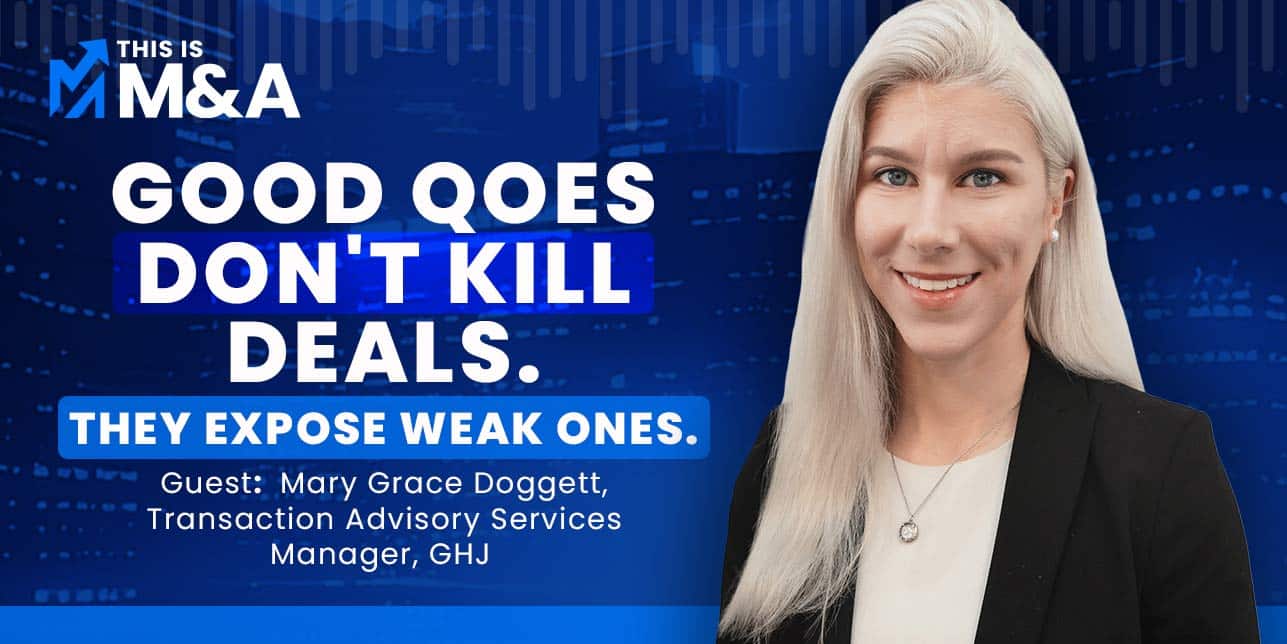
Many founders approach a Quality of Earnings (QoE) review with one fear:
What if it kills the deal?
According to Mary Grace Doggett, Transaction Advisory Services Manager at GHJ, that’s the wrong way to think about it.
A well-executed QoE doesn’t create problems.
It reveals the problems that already exist.
In the latest episode of This Is M&A, Steven Monterroso sits down with Mary Grace to explain what a Quality of Earnings review actually measures, why it matters far more than an audit during an acquisition, and how founders who prepare early consistently protect more of their company’s value. Drawing from her experience supporting buy-side and sell-side transactions ranging from $10 million to $1 billion, she offers a practical roadmap for navigating one of the most misunderstood parts of the M&A process.
A QoE Is Not an Audit
One of the biggest misconceptions founders have is assuming a Quality of Earnings review is simply another financial audit.
It isn’t.
An audit determines whether financial statements comply with accounting standards.
A Quality of Earnings review asks a very different question:
How much of this company’s earnings are sustainable after the acquisition closes?
Buyers aren’t purchasing historical financial statements.
They’re purchasing future cash flow.
A QoE helps determine whether reported EBITDA truly reflects the ongoing earning power of the business or whether adjustments need to be made before valuation can be established.
That distinction makes QoE one of the most important diligence exercises in any transaction.
The Best Sellers Diligence Themselves First
The strongest sellers don’t wait for buyers to discover issues.
They uncover them first.
Mary Grace recommends three core preparation steps before going to market:
- Normalize earnings early.
- Build defensible support for every EBITDA add-back.
- Ensure financial reporting is consistent month after month.
By addressing these items before buyers begin diligence, sellers maintain credibility and stay in control of the conversation.
Transparency early in the process almost always costs less than negotiating after unexpected issues surface.
Deals Don’t Break. They Unravel.
Most acquisitions don’t collapse because of one catastrophic discovery.
Instead, confidence erodes gradually.
Mary Grace describes it as deals unraveling.
Perhaps EBITDA adjustments aren’t fully supported.
Revenue isn’t as recurring as originally presented.
Customer concentration turns out to be higher than expected.
Working capital requires a larger adjustment.
Each issue alone may be manageable.
Together, they begin raising questions about management credibility and the accuracy of the seller’s financial story.
By the time multiple concerns emerge, negotiations often shift away from value creation and toward risk reduction.
Revenue Quality Is the First Place Buyers Look
Revenue isn’t simply measured by how much a company generates.
Buyers want to understand how predictable it is.
Mary Grace highlights several common revenue quality concerns:
- Inconsistent revenue recognition
- Project-based revenue presented as recurring
- Heavy customer concentration
- Revenue tied primarily to personal relationships rather than scalable systems
These issues directly influence valuation because they affect the predictability of future earnings.
If revenue cannot reasonably continue after the acquisition, buyers will adjust the purchase price accordingly.
EBITDA Add-Backs Must Be Defensible
Nearly every founder believes certain expenses should be added back when calculating adjusted EBITDA.
Sometimes they’re right.
Sometimes they aren’t.
Mary Grace emphasizes that every adjustment should be supported with clear documentation and logical reasoning.
Aggressive or poorly supported add-backs do more than reduce EBITDA.
They reduce trust.
Once buyers begin questioning one adjustment, they often become more skeptical of every other number presented throughout the diligence process.
Credibility becomes part of the valuation discussion.
You Can Win on EBITDA and Lose on Working Capital
Working capital receives far less attention than EBITDA, yet it frequently becomes one of the biggest negotiating points late in a transaction.
Seasonal inventory.
Slow collections.
Unexpected receivables.
Cash flow timing.
These factors influence the working capital peg and can materially affect purchase price, even when the agreed valuation remains unchanged.
Many founders don’t recognize this risk until negotiations are already underway.
Preparing early gives sellers time to understand these dynamics before they become expensive surprises.
Timing Matters More Than Most Founders Think
One of Mary Grace’s strongest recommendations is simple:
Run your sell-side QoE three to six months before launching the sale process.
That window provides enough time to identify issues, improve financial reporting, strengthen documentation, and resolve concerns before buyers begin asking difficult questions.
Once a Confidential Information Memorandum (CIM) has been distributed and the process is underway, every adjustment happens under pressure.
Preparation creates options.
Last-minute explanations create negotiations.
Control the Narrative Before the Buyer Does
The overarching lesson from the episode is that sellers who prepare early control the process.
Those who don’t often spend the transaction reacting instead of leading.
A well-organized data room, clean financial reporting, supported EBITDA adjustments, and transparent communication all demonstrate professionalism before buyers ever ask their first question.
That preparation doesn’t eliminate diligence.
It strengthens confidence.
And confidence is often what protects valuation.
Listen to the Full Episode
Mary Grace Doggett brings a practitioner’s perspective to one of the most important aspects of any acquisition. Her insights help founders understand not only what buyers evaluate during a Quality of Earnings review, but how thoughtful preparation can preserve value, accelerate diligence, and improve deal outcomes.
Whether you’re planning to sell next year or simply building a stronger business today, this episode offers practical guidance every founder should hear.
Listen to the latest episode of This Is M&A to learn why a good Quality of Earnings review doesn’t kill deals—it helps close better ones.