Private equity firms spend enormous effort evaluating financial statements, customer concentration, market opportunity, and management teams.
But many overlook one of the biggest drivers of future value.
The engineering organization.
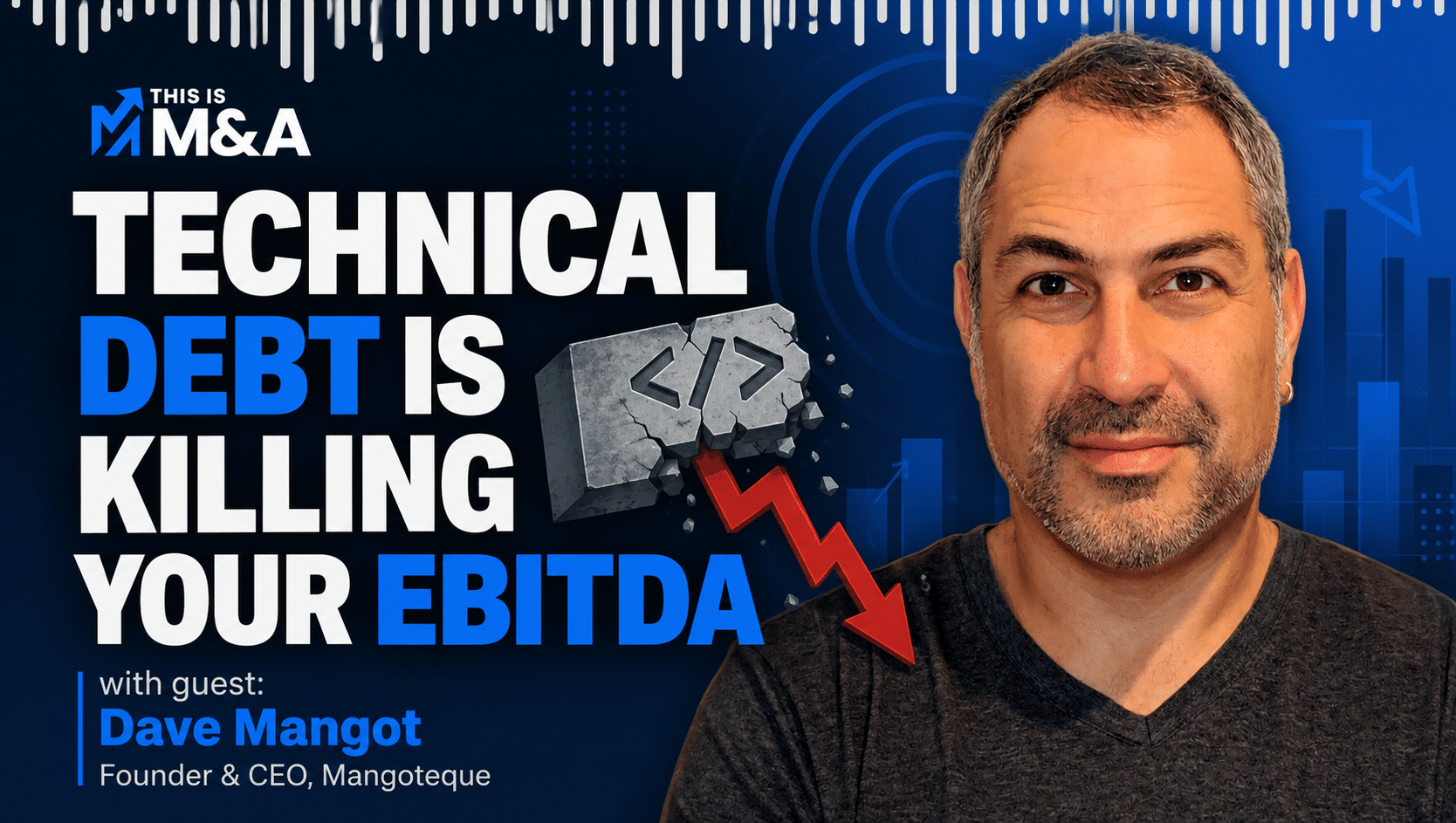
In the latest episode of This Is M&A, Steven Monterroso speaks with Dave Mangot, Founder and CEO of Mangoteque, about why technical debt, engineering performance, and software delivery have become critical valuation drivers for software companies. Drawing on his experience leading DevOps transformations at Salesforce, SolarWinds, and other enterprise technology companies, Dave explains why engineering isn’t just an IT function—it’s a major contributor to EBITDA, growth, and exit multiples.
The Engine Most PE Investors Never Look At
Most investors know how to read an income statement.
Far fewer know how to evaluate the engineering organization behind it.
That’s a problem.
According to Dave, engineering is often the hidden engine that determines whether a software company can continue growing after an acquisition. A company may report healthy recurring revenue today, but if its engineering team can’t release new features efficiently, fix issues quickly, or scale the platform, future growth becomes much harder.
The financials tell you where the business has been.
The engineering organization tells you where it’s capable of going.
Technical Debt Is Drag, Not Just Cost
Technical debt is frequently viewed as an engineering problem.
Dave argues it’s actually a business problem.
Every shortcut, outdated system, or poorly maintained codebase creates drag on the organization. Developers spend more time fixing old problems than building new capabilities. Product releases slow down. Innovation stalls. Costs increase.
Eventually, those operational inefficiencies show up in financial performance through higher operating costs, slower customer growth, reduced margins, and lower EBITDA.
Technical debt isn’t simply expensive.
It’s a velocity killer.
The Moneyball Principle for Software Companies
Dave compares software development to the principles made famous in Moneyball.
In baseball, more at-bats create more opportunities to score.
Software works much the same way.
The more frequently engineering teams can safely deploy new features, improvements, and fixes, the more opportunities the business has to create customer value.
Each deployment becomes another chance to improve retention, increase product adoption, or generate revenue.
Companies that release software daily have dramatically more opportunities to improve than organizations shipping updates every few months.
Speed, when paired with quality, becomes a competitive advantage.
What Investors Should Hear When the CTO Talks About DORA Metrics
Engineering leaders often discuss DORA metrics, but many executives and investors aren’t sure what they actually mean.
Dave breaks them down into business language.
DORA measures four key indicators of software delivery performance:
- Deployment frequency
- Lead time for changes
- Change failure rate
- Time to restore service
While these sound technical, each reflects business health.
High-performing engineering teams deliver software faster, recover from issues more quickly, and create less operational disruption.
For investors, these metrics offer insight into execution capability long before financial statements reveal problems.
They’re not simply engineering statistics.
They’re leading indicators of business performance.
Why AI Makes Broken Engineering Worse
Many organizations hope artificial intelligence will solve longstanding software development challenges.
Dave believes the opposite is true.
AI doesn’t eliminate poor engineering practices.
It amplifies them.
Organizations with clean processes, strong documentation, automated testing, and disciplined software delivery will see significant productivity gains.
Companies with disorganized systems and technical debt simply accelerate existing inefficiencies.
Before AI becomes a multiplier, organizations need the right foundations in place.
Otherwise, they’re simply moving faster in the wrong direction.
The Integration Mistake That Costs the Most
One of the most expensive mistakes private equity firms make happens after the acquisition closes.
Engineering teams remain siloed.
Separate development environments, duplicated infrastructure, disconnected processes, and isolated teams continue operating independently years after the transaction.
The result is higher costs, slower innovation, and missed opportunities to create operational leverage.
Successful acquirers recognize that engineering integration deserves the same attention as financial integration.
Done well, it creates meaningful efficiency gains.
Ignored, it quietly erodes value.
Engineering Alpha Is a Competitive Advantage
Dave introduces the concept of engineering alpha.
Just as investors seek alpha through superior performance, companies create engineering alpha by building software organizations that consistently outperform competitors.
This isn’t just about writing better code.
It’s about designing systems that allow teams to move faster, operate more efficiently, and deliver greater value with fewer resources.
Those operational advantages translate directly into stronger margins, better customer experiences, and ultimately higher company valuations.
Engineering excellence becomes financial performance.
Building a Company Buyers Want
The conversation reinforces an important lesson for founders and investors alike.
Buyers don’t simply evaluate today’s financial performance.
They evaluate tomorrow’s ability to execute.
For software companies, that means understanding the health of the engineering organization alongside the balance sheet.
Technical debt, software delivery, platform architecture, and engineering culture all influence how efficiently a company can grow after an acquisition.
The companies that invest in these foundations long before a sale position themselves to command stronger valuations when buyers begin asking questions.
Listen to the Full Episode
Dave Mangot has spent his career helping engineering organizations improve performance, eliminate technical debt, and create measurable business value. His insights bridge the gap between engineering and finance, giving investors and operators a practical framework for evaluating one of the most overlooked drivers of software company value.
Whether you’re a founder preparing for an exit, a private equity investor evaluating software companies, or an executive leading digital transformation, this episode offers valuable lessons on how engineering performance translates directly into business performance.
Listen to the latest episode of This Is M&A to learn why engineering may be the biggest valuation lever your deal team isn’t measuring.
Need a data room for your next high-stakes deal? See what ShareVault can do for you.