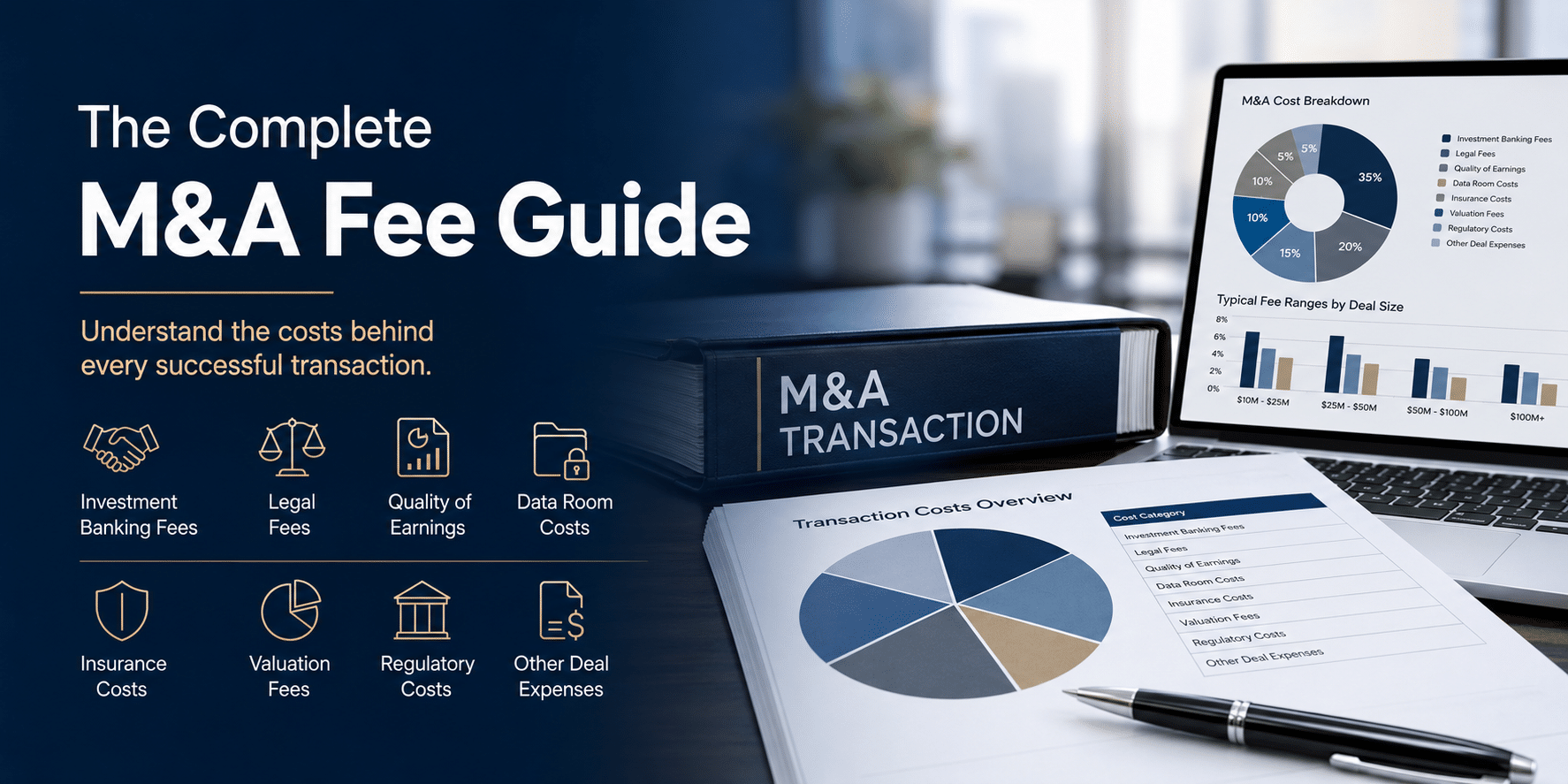
Selling a business is often the largest financial transaction an owner will ever complete. Yet many executives underestimate the costs associated with bringing a deal to market and successfully closing it.
Beyond negotiating a purchase price, mergers and acquisitions require investment bankers, attorneys, accountants, tax advisors, diligence specialists, technology providers, and in many cases insurance professionals. Each plays a distinct role in reducing risk, validating information, and helping both parties navigate a complex transaction.
While every deal is unique, understanding where these costs come from can help business owners budget appropriately, compare advisors more effectively, and avoid surprises during the sale process.
This guide explains the most common fees associated with middle market M&A transactions in the United States.
Investment Banking Fees
For most middle market transactions, investment banking fees represent the largest professional expense.
Investment banks typically receive a monthly retainer while actively marketing the business, followed by a success fee when the transaction closes. The success fee aligns the advisor’s interests with the seller by rewarding a successful outcome rather than simply the amount of work performed.
Many firms still reference the traditional Lehman Formula, although modern fee structures are often negotiated based on transaction size, complexity, and expected marketing effort.
Typical fee structures include:
- Monthly retainers ranging from $5,000 to $50,000
- Success fees ranging from 2 percent to 8 percent of enterprise value
- Minimum success fee commitments for smaller transactions
- Reimbursement of reasonable travel and marketing expenses
Generally, the larger the transaction, the lower the percentage fee. A $20 million acquisition may carry a significantly higher percentage than a $500 million transaction.
When evaluating advisors, sellers should focus on experience, buyer relationships, industry expertise, and execution capability rather than selecting the lowest fee proposal.
Legal Fees
Legal counsel protects both buyers and sellers throughout the transaction.
Attorneys prepare and negotiate letters of intent, purchase agreements, disclosure schedules, employment agreements, escrow arrangements, and numerous supporting documents.
Legal costs vary considerably depending on transaction complexity, regulatory requirements, and the number of negotiation rounds.
Typical ranges include:
- Lower middle market transactions: $30,000 to $100,000
- Middle market transactions: $100,000 to $500,000
- Complex cross border or regulated transactions: $500,000 and above
The most expensive legal bills are often the result of poorly organized diligence or unresolved issues discovered late in the process.
Quality of Earnings Reports
A Quality of Earnings report provides buyers with an independent assessment of a company’s financial performance.
Prepared by an accounting or advisory firm, the report examines revenue quality, expense normalization, working capital, accounting policies, and potential financial risks.
Quality of Earnings reports have become increasingly common in private equity transactions because they provide buyers with greater confidence before submitting final offers.
Typical costs range from:
- $25,000 to $150,000
Highly complex businesses or multinational companies may incur higher costs.
Financial and Tax Advisory Fees
Accounting firms frequently support transactions beyond the Quality of Earnings report.
Services may include:
- Tax structuring
- Purchase price allocation
- Working capital analysis
- Financial modeling
- Closing statement review
- Post closing tax planning
Typical fees range from $10,000 to more than $250,000, depending on transaction complexity.
Virtual Data Room Costs
A virtual data room serves as the secure environment where confidential documents are shared during due diligence.
Pricing varies depending on storage requirements, project duration, user count, and feature set.
Common pricing models include:
- Monthly subscriptions
- Annual subscriptions
- Per project pricing
- Enterprise licensing
Most organizations should evaluate providers based on security, ease of use, reporting capabilities, customer support, and administrative controls rather than price alone.
The cost of a virtual data room is often insignificant compared to the potential cost of delays, security incidents, or lost buyer confidence.
Representation and Warranty Insurance
Representation and Warranty Insurance has become increasingly common in middle market transactions.
Rather than relying solely on seller indemnification, buyers can purchase insurance that covers certain breaches of representations and warranties.
Typical premiums range from approximately 2 percent to 4 percent of policy limits, with additional underwriting costs and deductibles.
Whether insurance is appropriate depends on transaction size, buyer requirements, and negotiated risk allocation.
Business Valuation Fees
Independent business valuations may be required for shareholder planning, tax purposes, litigation support, or fairness opinions.
Typical valuation costs include:
- Small businesses: $5,000 to $15,000
- Middle market companies: $15,000 to $50,000
- Complex or regulated businesses: $50,000 and above
Environmental and Technical Assessments
Certain industries require additional diligence beyond financial review.
Manufacturing, energy, healthcare, chemicals, and real estate transactions may involve:
- Phase One Environmental Site Assessments
- Phase Two Environmental Testing
- Engineering reports
- Asset inspections
- Information security assessments
- Intellectual property reviews
These specialized reports can range from a few thousand dollars to well over six figures depending on scope.
Government Filing and Regulatory Costs
Some transactions require regulatory approval before closing.
Potential costs include:
- Hart Scott Rodino filing fees
- Industry specific licensing reviews
- Healthcare approvals
- Financial services approvals
- Defense and government contracting reviews
- International regulatory filings
Regulatory costs vary widely depending on transaction size and industry.
Hidden Costs That Sellers Often Overlook
Many sellers budget for advisors but overlook the internal resources required to support a transaction.
Common hidden costs include:
- Management time
- Financial cleanup
- Document preparation
- Customer contract reviews
- Board meetings
- Travel expenses
- Employee retention bonuses
- Information technology support
- Cybersecurity improvements
- Data room administration
These expenses may not appear as professional fees, but they can significantly impact the total cost of a transaction.
Sample Middle Market M&A Budget
| Expense | Estimated Range |
|---|---|
| Investment Banking | $250,000 to $2,000,000+ |
| Legal Counsel | $30,000 to $500,000+ |
| Quality of Earnings | $25,000 to $150,000 |
| Tax and Accounting | $10,000 to $250,000+ |
| Virtual Data Room | $2,000 to $30,000+ |
| Representation and Warranty Insurance | Varies by policy |
| Valuation | $5,000 to $50,000+ |
| Environmental and Technical Reports | Varies by industry |
How to Reduce M&A Costs Without Increasing Risk
The most effective way to reduce transaction costs is not by eliminating advisors. It is by reducing inefficiencies.
Companies that prepare financial records early, organize contracts, resolve outstanding legal issues, maintain accurate corporate records, and establish a structured due diligence process typically experience fewer delays and fewer expensive surprises.
Choosing experienced advisors also pays dividends. A seasoned investment banker, attorney, or accounting firm may command a higher fee but often prevents mistakes that cost far more than the initial engagement.
Finally, investing in secure technology and organized information management can shorten diligence timelines, improve buyer confidence, and help transactions move forward more efficiently.
Final Thoughts
Every M&A transaction is different, and there is no universal fee schedule that applies to every deal. Costs vary based on transaction size, industry, complexity, regulatory requirements, and the advisors involved.
Rather than viewing these expenses as isolated line items, business owners should consider them investments in a successful outcome. The right team can help preserve valuation, reduce execution risk, and increase the likelihood of reaching the closing table.
Understanding where these costs originate allows sellers to plan more effectively and enter the market with realistic expectations and greater confidence.
Frequently Asked Questions
How much does it cost to sell a business?
Most middle market sellers should expect professional fees ranging from tens of thousands to several million dollars depending on deal size and complexity.
Who pays the investment banker?
In sell side transactions, the seller typically pays the investment banking fees upon closing.
Are success fees negotiable?
Yes. Success fees, retainers, minimum fees, and expense reimbursements are all negotiable and vary by advisor and transaction.
What is usually the largest M&A expense?
Investment banking fees are often the largest professional cost, followed by legal fees and financial diligence.
Do all deals require a Quality of Earnings report?
No, but they are increasingly common in private equity and larger middle market transactions because they help buyers validate financial performance.
How much does a virtual data room cost?
Costs vary by provider, storage, users, and subscription model, but they are typically a small percentage of the total transaction cost.
Can poor preparation increase M&A costs?
Yes. Disorganized records, delayed responses, and unresolved issues often lead to higher legal, accounting, and advisory fees.
Should founders choose the advisor with the lowest fee?
Not necessarily. Experience, execution, and buyer relationships often have a much greater impact on transaction value than modest differences in advisor fees.