Most Companies Think They’re Ready—Until the Deal Starts
Ask most founders or executives if they’re prepared for a deal, and the answer is almost always yes.
They have financials.
They have contracts.
They have folders full of documents.
On paper, everything looks ready.
But the moment a deal actually begins—everything changes.
Requests start coming in.
Questions pile up.
Documents need to be found, verified, updated.
And suddenly, “prepared” doesn’t feel so prepared anymore.
Because in M&A, there’s a big difference between having information… and being able to operate under pressure.

Prepared Means You Have the Documents
Being prepared is passive.
It means:
- Your files exist
- Your data is somewhere
- Your team can eventually find what’s needed
Most companies fall into this category.
They’ve been running the business. They’ve accumulated documents over time. And when a deal becomes a possibility, they assume that’s enough.
It’s not.
Because deals don’t run on static information—they run on execution.
Deal-Ready Means You Can Run the Process
Being deal-ready is active.
It means:
- Your information is structured
- Your documents are current and validated
- Your team knows exactly where everything is
- You can respond quickly and confidently
More importantly, it means you can manage the process, not just the data.
Deal-ready teams don’t scramble.
They don’t react.
They operate with control.
And that difference shows up immediately to buyers.
Why This Gap Matters More Than You Think
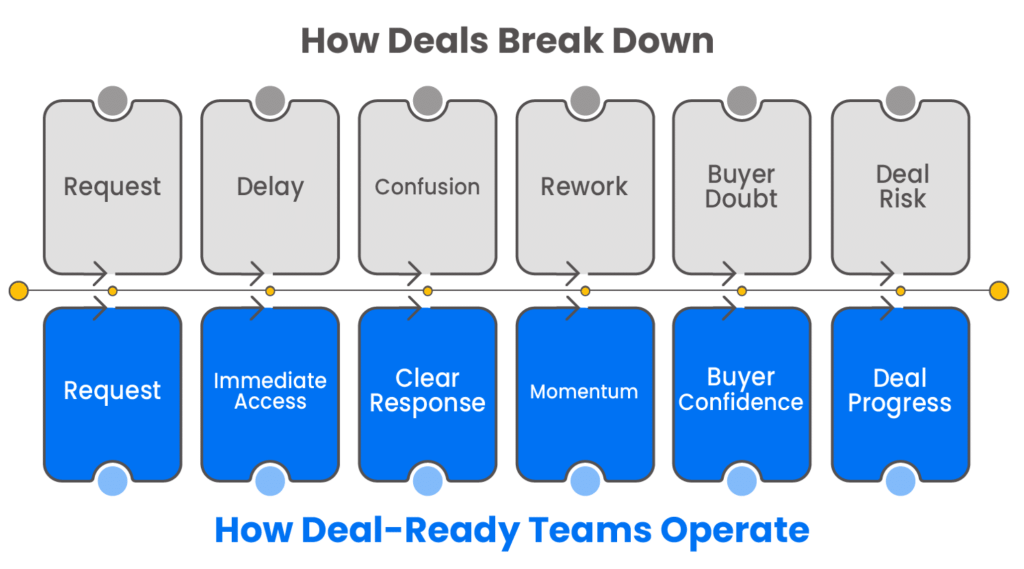
Buyers don’t just evaluate the business—they evaluate the experience of the deal.
A slow, disorganized process signals risk.
A clean, responsive process builds confidence.
Two companies with similar financials can have very different outcomes based on how the deal is run.
One feels tight, professional, and controlled.
The other feels chaotic, delayed, and uncertain.
Guess which one gets better terms.
Where Most Teams Break Down
The gap between prepared and deal-ready usually shows up in the same places.
Disorganized Information
Documents exist—but they’re scattered.
Different versions.
Unclear naming.
No consistent structure.
Buyers spend more time searching than evaluating.
Slow Response Cycles
Requests come in—but responses lag.
No clear ownership.
No tracking system.
No urgency.
Momentum stalls, and with it, confidence.
Reactive Communication
Teams wait for questions instead of anticipating them.
Each new request becomes a scramble.
Each delay creates more friction.
Instead of guiding the process, they’re constantly catching up to it.
Lack of Visibility
No one has a clear view of what’s happening.
What’s been shared?
What’s still outstanding?
What’s raising concerns?
Without visibility, small issues turn into bigger problems.
What Deal-Ready Teams Do Differently
High-performing deal teams don’t leave this to chance.
They build readiness into how they operate.
They Structure Everything Upfront
Documents aren’t just stored—they’re organized with intent.
Clear categories.
Consistent naming.
Logical flow.
Buyers can move through information without friction.
They Prepare Before Going to Market
They don’t wait for diligence to begin.
They:
- Audit their documents
- Fill gaps early
- Anticipate key questions
By the time buyers show up, they’re already ahead.
They Move with Speed and Discipline
Every request has:
- Ownership
- A timeline
- A clear response
Speed isn’t reactive—it’s built into the process.
They Control the Narrative
They know what buyers are seeing.
They understand where attention is going.
They stay ahead of concerns before they escalate.
They’re not reacting to the deal—they’re running it.
The Real Advantage of Being Deal-Ready
Being deal-ready isn’t just about efficiency.
It’s about outcomes.
- Faster timelines
- Fewer surprises
- Stronger buyer confidence
- Better positioning in negotiations
When buyers feel clarity and control, they move forward with conviction.
And conviction drives value.
Prepared Isn’t Enough Anymore
In today’s market, buyers have options.
They compare not just businesses—but processes.
If your deal feels slow, messy, or uncertain, they don’t wait around.
They move on.
Or they adjust their offer to account for the risk.
That’s the cost of not being deal-ready.
Run a Better Deal
Having documents isn’t the same as being ready.
Being ready means you can move fast.
Stay organized.
Maintain control.
And create a process buyers trust.
Because in M&A, the outcome isn’t just determined by what you’re selling.
It’s determined by how you run the deal.
Run a better deal. The outcome depends on it.