
For decades, due diligence followed a familiar pattern.
A buyer signed a Letter of Intent. Documents were requested. Questions were exchanged. Teams spent weeks or months reviewing financial statements, contracts, operational data, customer relationships, and legal records before determining whether the opportunity matched expectations.
Today, that process is changing rapidly.
Artificial intelligence is not replacing dealmakers, investment bankers, attorneys, or private equity professionals. It is making them faster. And as buyers gain access to increasingly sophisticated tools, the standard for what constitutes a “diligence ready” company is rising.
The result is simple: buyers are identifying risks, inconsistencies, and opportunities much earlier in the process than ever before.
For sellers, this creates both a challenge and an opportunity.
The companies that embrace this new reality will command stronger valuations, create smoother transactions, and build greater confidence among buyers. Those that do not may find themselves struggling to answer questions they never expected to face.
AI Is Compressing the Due Diligence Timeline
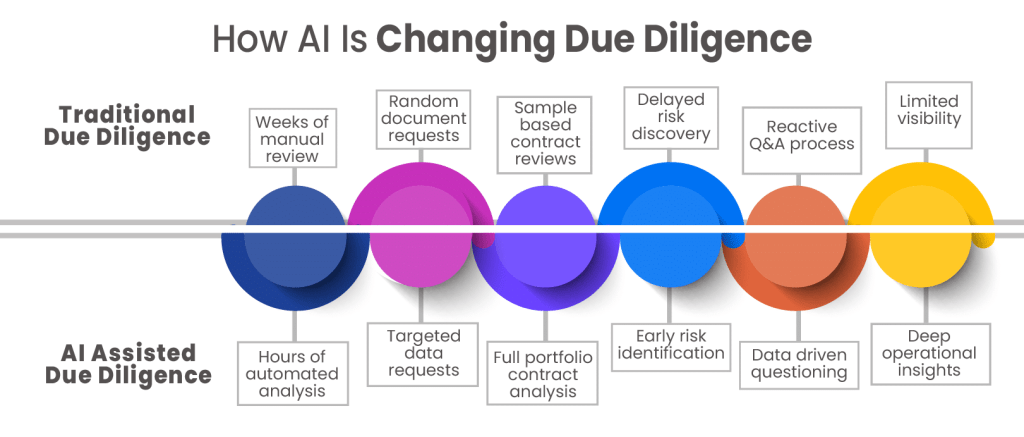
Historically, diligence teams relied heavily on manual review.
Financial analysts combed through spreadsheets. Attorneys reviewed contracts line by line. Operating partners interviewed management teams to understand processes and uncover risks.
While these activities remain essential, AI is dramatically reducing the time required to analyze large volumes of information.
Modern diligence teams can now leverage AI tools to:
- Review thousands of contracts in hours instead of weeks
- Identify unusual clauses and legal risks
- Detect revenue concentration issues
- Analyze customer retention trends
- Compare historical financial performance against industry benchmarks
- Surface inconsistencies across multiple datasets
- Flag missing documents and information gaps
What once required large teams and extended timelines can now happen at unprecedented speed.
As a result, buyers are arriving at management meetings with more information and more specific questions than ever before.
The End of “We’ll Organize It Later”
Many companies still treat due diligence preparation as a task that begins after a decision has been made to sell, raise capital, or pursue a strategic transaction.
That mindset is becoming increasingly risky.
AI excels at finding patterns.
It also excels at finding missing information.
When buyers upload documents into their review systems, incomplete records, outdated agreements, missing signatures, inconsistent reporting, and conflicting data often become visible immediately.
What previously might have remained hidden until late in the process can now surface within days.
This shift means that organizations must think about diligence readiness long before entering the market.
The question is no longer whether your information exists.
The question is whether your information is organized, accessible, complete, and capable of standing up to increasingly sophisticated analysis.
Buyers Are Looking Beyond Financial Performance
Strong revenue growth and healthy margins remain important.
But AI is allowing buyers to evaluate businesses more holistically.
Instead of focusing exclusively on financial statements, buyers can analyze operational indicators that provide deeper insights into future performance.
Areas receiving increased scrutiny include:
- Customer concentration
- Employee turnover
- Contract renewal trends
- Regulatory compliance
- Intellectual property ownership
- Vendor dependencies
- Cybersecurity practices
- Data governance procedures
These factors often reveal risks that traditional financial analysis alone may miss.
For sellers, this means operational discipline has become a competitive advantage.
Companies that maintain organized records and strong internal controls often create greater confidence among buyers and investors.
Confidence frequently translates into stronger negotiating positions.
Why Data Quality Is Becoming a Valuation Driver
One of the most overlooked aspects of modern dealmaking is the growing relationship between data quality and valuation.
Buyers place a premium on certainty.
When information is incomplete, disorganized, or difficult to verify, uncertainty increases.
Uncertainty creates risk.
Risk lowers value.
The opposite is also true.
When management teams provide clear documentation, organized records, and transparent reporting, buyers gain confidence in the investment thesis.
The result can be fewer delays, fewer surprises, and greater willingness to support premium valuations.
In many cases, the quality of information presented during diligence influences transaction outcomes just as much as the information itself.
The Rise of the Intelligent Data Room
Virtual data rooms have long served as secure repositories for confidential information.
Today, their role is expanding.
The modern data room is becoming a strategic command center for transactions.
Instead of simply storing documents, organizations increasingly use data rooms to:
- Organize information before a process begins
- Manage access across multiple stakeholders
- Track buyer engagement
- Protect sensitive information
- Accelerate responses to diligence requests
- Maintain audit trails and compliance records
- Streamline collaboration among advisors and deal teams
As AI becomes more integrated into transaction workflows, the importance of structured, secure, and well managed information environments will continue to grow.
Companies that view their data room as a strategic asset rather than a storage location will be better positioned to navigate the evolving demands of buyers.
What Sellers Should Do Right Now
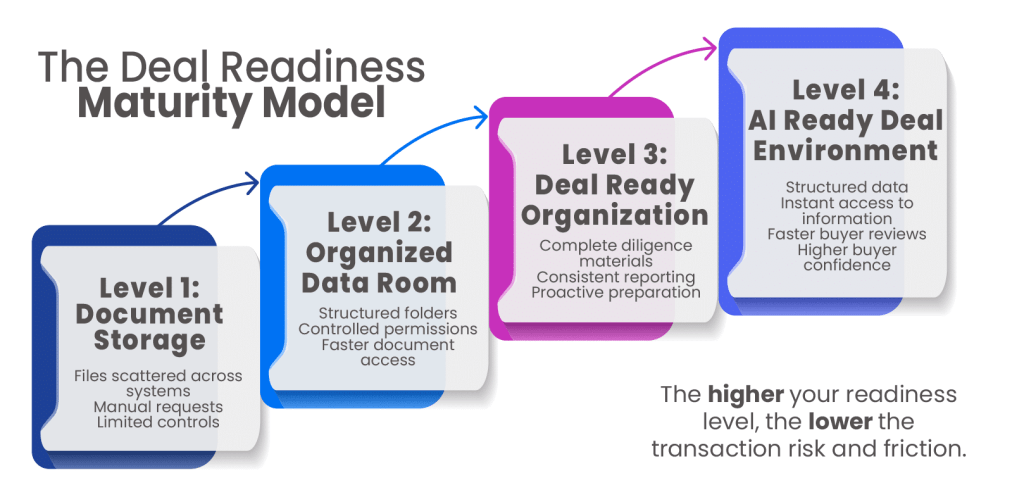
The most successful transactions begin long before a company officially enters the market.
Management teams should start preparing by asking several critical questions:
- Are our key documents current and complete?
- Can we quickly respond to buyer requests?
- Are contracts properly organized?
- Is our financial reporting consistent?
- Have we identified potential diligence concerns before a buyer does?
- Are sensitive documents adequately protected?
Addressing these questions early creates flexibility later.
More importantly, it reduces the likelihood of surprises during a transaction.
The Future of Due Diligence
The future of dealmaking will not belong to organizations with the largest datasets.
It will belong to organizations with the most trusted datasets.
AI is making diligence faster, deeper, and more comprehensive. Buyers have greater visibility than ever before. Expectations are increasing. Timelines are shrinking.
In this environment, preparation is no longer optional.
Companies that embrace diligence readiness as an ongoing discipline rather than a one time event will be better positioned to attract investors, negotiate from strength, and close transactions successfully.
The rules of due diligence are changing.
The organizations that recognize that shift today will have a significant advantage tomorrow.