Deals Don’t Die Loudly—They Die Quietly
Most deals don’t collapse in a dramatic moment.
There’s no single email, no final call where everything falls apart. Instead, deals erode. Slowly. Quietly.
A delayed response here.
A missing document there.
A growing sense of doubt on the buyer’s side.
By the time the deal dies, it’s already been slipping for weeks.
Due diligence is where that erosion happens—or where confidence is built.
Time kills deals. But friction kills them faster.
Due Diligence Isn’t Just Verification—It’s Validation
Too many sellers treat due diligence like a checklist.
Upload the documents. Answer the questions. Get through it.
But buyers aren’t just verifying information—they’re evaluating how the business operates.
They’re asking:
- Can this team execute under pressure?
- Is this company organized?
- Are there risks hiding beneath the surface?
Due diligence is often the first real look behind the curtain.
A clean, structured process builds confidence.
A messy one raises questions.
5 Reasons Deals Fall Apart During Due Diligence
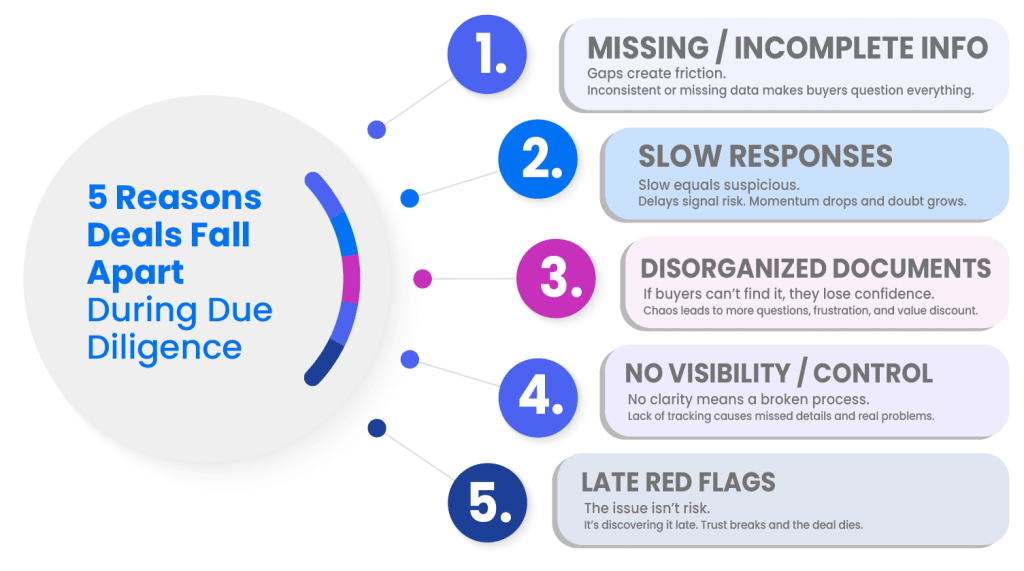
1. Missing or Incomplete Information
Nothing slows a deal faster than gaps.
Financials that don’t tie out.
Legal documents that aren’t ready.
Multiple versions of the same file with no clarity on what’s current.
Every gap creates friction—and friction invites scrutiny.
And once buyers start questioning the data, they start questioning everything.
2. Slow Response Times
Speed isn’t just operational—it’s psychological.
When questions sit unanswered, buyers don’t assume you’re busy.
They assume something’s wrong.
Momentum stalls. Energy drops. Doubt creeps in.
Speed is a signal. Slow responses feel like risk.
3. Disorganized Document Structure
If buyers can’t find what they need, the deal starts working against you.
Folders with no logic.
Files buried three layers deep.
Outdated documents mixed with current ones.
The result: repeated questions, frustration, and lost confidence.
And once a buyer feels friction in the process, they begin to discount the opportunity.
4. Lack of Visibility and Control
Deals fall apart when no one has a clear view of what’s happening.
What’s been reviewed?
What’s still outstanding?
Where are the buyers focusing?
When diligence lives across email threads, shared drives, and disconnected tools, things get missed.
And in M&A, missed details turn into real problems.
5. Red Flags Discovered Too Late
Every business has issues.
Customer concentration.
Compliance gaps.
Unresolved legal matters.
These don’t automatically kill a deal.
Surprises do.
When risks surface late in the process, buyers feel blindsided—and that’s when trust breaks.
And once trust breaks, recovery is rare.
The Hidden Cost of Due Diligence Failure
By the time a deal falls apart, the damage is already done.
- Legal and advisory fees have piled up
- Internal teams have spent months distracted
- Momentum in the business has slowed
- Buyers have walked—or come back with lower offers
And the hardest part?
You don’t get that time back.
By the time a deal fails, the cost has already been paid.
How to Prevent Deals from Falling Apart

The difference between a smooth deal and a failed one isn’t luck.
It’s preparation. Structure. Execution.
1. Get Organized Before the Deal Starts
Most teams wait until diligence begins to get their house in order.
That’s too late.
Build your document structure early.
Standardize naming conventions.
Ensure everything is complete, accurate, and current.
Prepared teams move faster—and faster teams win.
2. Centralize Everything
Fragmentation creates friction.
When documents, communication, and tracking live in different places, deals slow down.
You need a single source of truth—one place where everything lives, updates, and gets reviewed.
Clarity accelerates decisions.
3. Prioritize Speed and Responsiveness
Every diligence request should have ownership.
Who’s responsible?
What’s the timeline?
What’s the status?
Fast responses maintain momentum—and momentum keeps deals alive.
4. Anticipate Buyer Questions
The best deal teams don’t just react—they prepare.
Think like a buyer:
- What would you question?
- What would you want to validate?
- What risks would you look for?
Pre-loading answers reduces friction and builds trust early.
5. Maintain Control and Visibility
You should always know:
- What buyers are reviewing
- What documents are getting attention
- Where concerns may be forming
Visibility isn’t just operational—it’s strategic.
It allows you to manage the narrative, not react to it.
What High-Performing Deal Teams Do Differently
The best teams don’t treat due diligence as a phase.
They treat it as a process.
They prepare before going to market.
They move with urgency.
They communicate clearly.
They eliminate friction wherever possible.
Great deals aren’t just negotiated well—they’re run well.
Deal Outcomes Are Decided in the Process
Deals rarely fail because of one major issue.
They fail because of accumulated friction:
- Delays
- Confusion
- Lack of clarity
- Loss of confidence
When the process breaks down, the deal follows.
When the process is tight, structured, and controlled, outcomes improve.
The difference between a closed deal and a collapsed one is rarely the business. It’s how the deal is run.
Run a Better Deal
If you’re preparing for a transaction, the question isn’t whether you’re ready.
It’s whether your process is.
Because in M&A, preparation isn’t a box to check—it’s a competitive advantage.
Run a better deal. The outcome depends on it.