The Modern M&A Process Has Outgrown Legacy VDR Thinking
For years, platforms like iDeals became synonymous with virtual data rooms.
They helped digitize due diligence during a period when simply replacing physical deal rooms with online document storage felt revolutionary.
But the M&A world of 2026 looks nothing like the M&A world of 2012.
Deals move faster. Buyer pools are larger. Cross-border transactions are more common. Cyber threats are more sophisticated.
And deal teams are under enormous pressure to execute efficiently with leaner internal resources.
That shift is exposing a growing problem inside the VDR industry:
Many legacy platforms were built for a slower era of dealmaking.
Today’s investment bankers don’t just need secure file storage.
They need speed.
Usability.
Visibility.
Responsiveness.
Operational efficiency.
In other words, they need technology that accelerates deals instead of slowing them down.
That’s why a growing number of firms are reevaluating older virtual data room providers and moving toward more modern platforms like ShareVault.
The Hidden Cost of Legacy Data Rooms
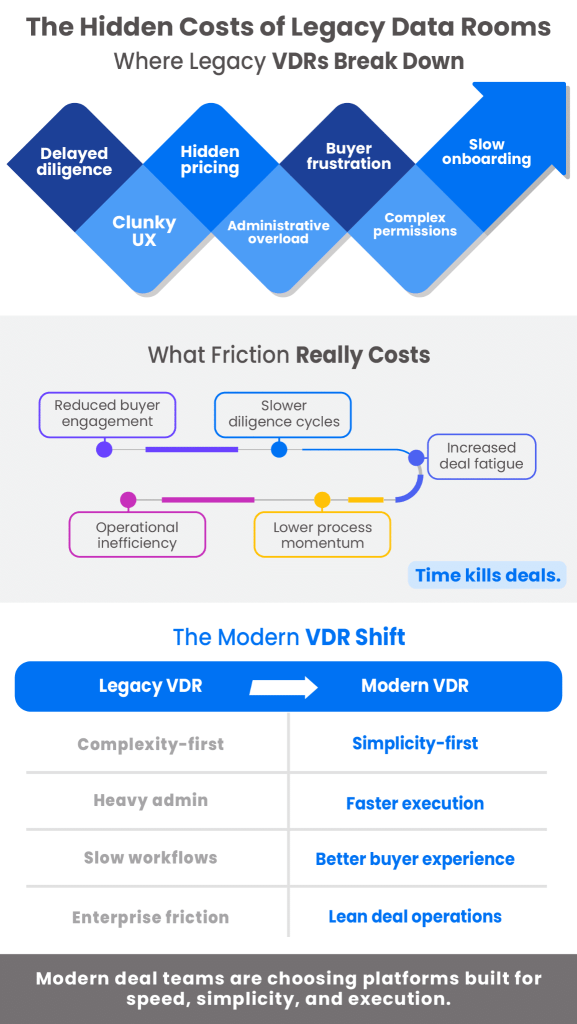
Most firms evaluate a virtual data room based on security checkboxes and feature lists.
But experienced dealmakers know the real question is much simpler:
“Does this platform help us move deals faster—or create friction?”
Because friction is expensive.
According to Deloitte, failed integrations, communication breakdowns, and process inefficiencies remain among the leading causes of transaction delays and underperformance in M&A.
And while virtual data rooms are only one piece of the process, they sit at the center of nearly every interaction buyers have with deal materials.
That means every point of friction matters.
A confusing interface.
Slow indexing.
Permission headaches.
Buyer frustration.
Clunky navigation.
Delayed uploads.
These aren’t minor inconveniences during a live transaction.
They directly affect buyer engagement and deal momentum.
As one middle-market banker recently told Mergers & Acquisitions Magazine:
“The best data room is the one buyers stop noticing because everything just works.”
That statement captures the direction the industry is moving.
The modern VDR shouldn’t feel like enterprise software from another decade.
It should feel invisible.
Fast.
Intuitive.
Effortless.
Why Legacy Platforms Are Starting to Feel Outdated
The original generation of VDR providers was designed around administrative control.
The philosophy was simple:
More permissions.
More configuration.
More settings.
More layers.
More complexity.
At the time, complexity was often interpreted as sophistication.
But today’s deal teams are learning the opposite is true.
Complexity creates operational drag.
And operational drag kills efficiency.
This is especially problematic in the middle market, where lean deal teams are expected to manage multiple transactions simultaneously.
A 2025 PwC report on dealmaking trends found that transaction teams are under increasing pressure to shorten timelines while handling larger volumes of diligence data than ever before.
That creates a dangerous mismatch between modern deal demands and older VDR infrastructure.
Because many legacy platforms still require:
- Heavy administrative oversight
- Steep onboarding curves
- Complex permission structures
- Manual workflows
- Excessive configuration
In theory, those systems offer “control.”
In practice, they often create bottlenecks.
And investment bankers have little patience for bottlenecks.
The Buyer Experience Problem Nobody Talks About
Most VDR conversations focus entirely on the seller-side experience.
But seasoned M&A professionals understand something critical:
The buyer experience matters just as much.
Every interaction inside a data room shapes how buyers perceive the professionalism and organization of a transaction.
If the platform feels outdated, difficult to navigate, or unnecessarily cumbersome, buyer engagement drops.
That’s not speculation.
According to research from Gartner, user experience and workflow efficiency are now among the primary drivers behind enterprise software replacement decisions.
The same logic applies directly to M&A.
Buyers expect modern software experiences.
Not bloated enterprise systems.
Not interfaces that require training sessions.
Not platforms that feel ten years behind the rest of the technology stack.
One private equity associate described the issue bluntly in a recent industry panel:
“If buyers are spending more time figuring out the data room than analyzing the deal, you’ve already created unnecessary friction.”
That’s one of the biggest reasons modern VDR providers are gaining traction.
The industry is shifting away from complexity-first design.
And toward usability-first execution.
Why ShareVault Is Emerging as a Modern Alternative
ShareVault’s positioning inside the market is fundamentally different from many legacy providers.
Instead of designing around administrative complexity, ShareVault focuses on operational simplicity without sacrificing enterprise-grade security.
That distinction matters enormously during live transactions.
Because deal teams don’t need more software complexity.
They need fewer obstacles.
The platform is designed to help firms:
Launch faster.
Organize diligence efficiently.
Keep buyers engaged.
Reduce administrative burden.
Maintain security without slowing workflows.
And ultimately move transactions forward with less friction.
That operational efficiency is becoming a major competitive differentiator.
Especially as firms handle increasing transaction volume with leaner internal teams.
Speed Is Becoming the New Competitive Advantage
Historically, VDR providers competed primarily on security.
Today, speed and usability are becoming equally important.
According to EY’s Global Capital Confidence Barometer, dealmakers increasingly view operational agility as a critical factor in transaction execution.
That mindset extends directly into the technology stack supporting the deal process.
Because modern transactions move incredibly fast.
Investment bankers are often managing:
Multiple buyers.
Simultaneous diligence requests.
Cross-functional stakeholders.
Aggressive timelines.
Remote collaboration.
Global participants.
Under those conditions, even small inefficiencies compound quickly.
One delayed permission request.
One confusing folder structure.
One inaccessible document.
One sluggish workflow.
That’s all it takes to create unnecessary friction.
Modern VDR platforms recognize this reality.
And they’re prioritizing streamlined execution accordingly.
Simplicity Is No Longer a Luxury
One of the biggest misconceptions in enterprise software is that simplicity equals limited functionality.
The opposite is increasingly true.
The best modern platforms remove unnecessary complexity while preserving powerful capabilities underneath.
That’s the direction software across every category is moving.
M&A technology is no exception.
ShareVault reflects that broader shift.
The platform emphasizes:
- Faster onboarding
- Cleaner navigation
- Easier administration
- Transparent pricing
- Secure collaboration
- Buyer-friendly usability
- Faster deployment
Without overwhelming users with excessive operational friction.
That simplicity matters more than ever because many deal teams simply don’t have the internal bandwidth for bloated software administration.
As one managing director at a boutique investment bank recently explained:
“We’re not looking for software that gives us more work. We’re looking for software that gets out of the way.”
That quote perfectly captures where the VDR market is heading.
The Industry Is Moving Toward Modern VDR Platforms
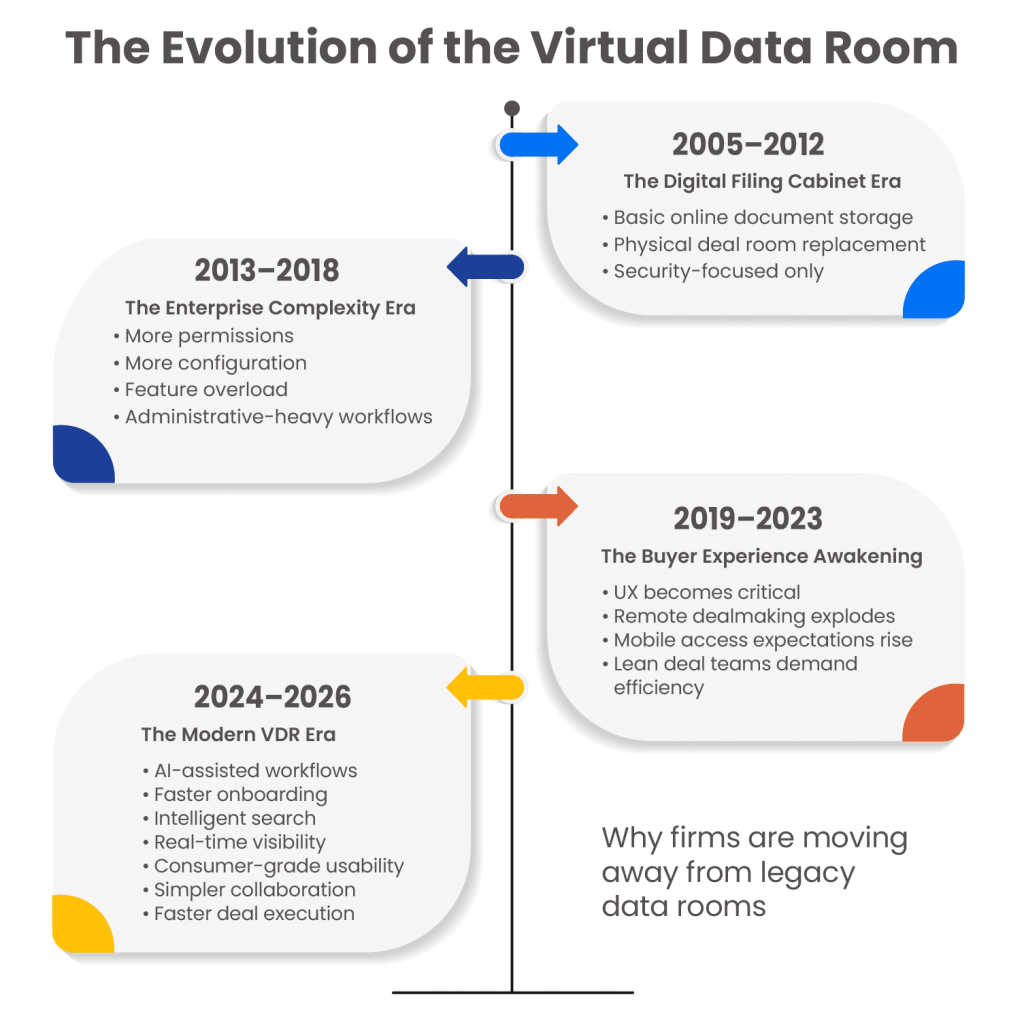
The broader VDR market is undergoing a significant transformation.
Artificial intelligence, automation, intelligent search, advanced analytics, and real-time visibility are rapidly reshaping expectations.
At the same time, buyers increasingly expect consumer-grade software experiences even inside highly complex enterprise workflows.
That combination is forcing the industry to evolve.
Fast.
The next generation of VDR platforms will likely be defined less by feature overload and more by:
Efficiency.
Usability.
Automation.
Visibility.
And seamless collaboration.
That evolution is already happening.
And many firms are beginning to realize that older platforms built around legacy design philosophies may no longer align with how modern transactions operate.
Final Thoughts: The Best VDR Is the One That Removes Friction
There’s a reason more investment bankers, private equity firms, attorneys, and corporate development teams are reevaluating legacy data room providers.
The demands of modern dealmaking have changed.
And the technology supporting those deals needs to evolve alongside it.
Today’s firms want platforms that are:
Fast.
Intuitive.
Secure.
Transparent.
Easy to manage.
Easy for buyers to navigate.
And capable of supporting high-stakes transactions without introducing unnecessary operational complexity.
That’s exactly why modern alternatives like ShareVault.