
There is an old saying in dealmaking that time kills deals. While every transaction is unique, the principle has become increasingly relevant in today’s market.
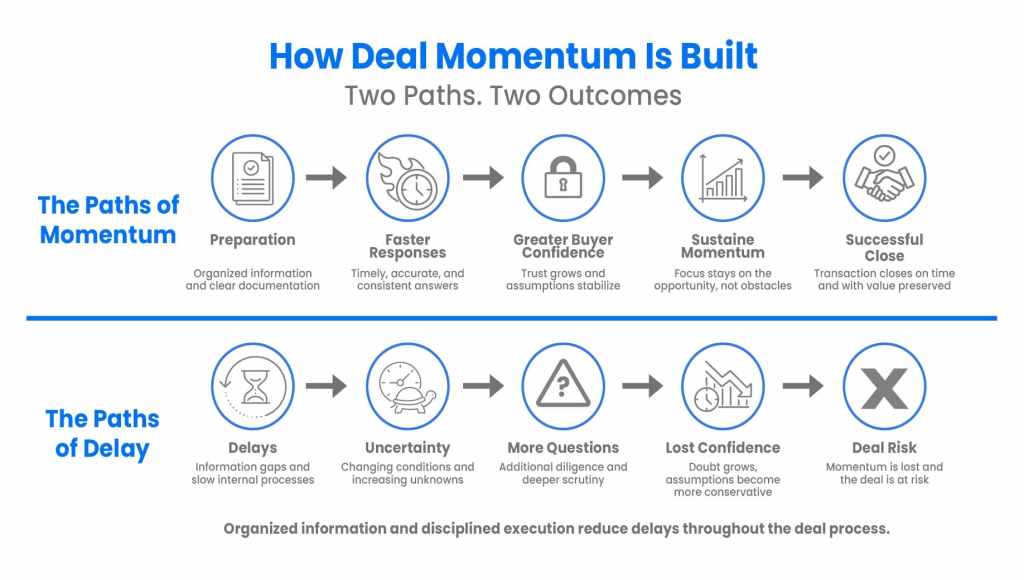
Lengthy diligence cycles, delayed decisions, and disorganized processes do more than frustrate buyers and sellers. They introduce uncertainty at every stage of a transaction. As uncertainty grows, confidence declines, financing assumptions change, and competing priorities begin to emerge. Rarely does a deal fall apart because of a single issue. More often, momentum is lost through a series of small delays that gradually erode trust between both parties.
This is why speed has become one of the most valuable competitive advantages in modern M&A. Not because deals should be rushed, but because the firms that eliminate unnecessary friction consistently put themselves in a stronger position to reach the finish line.
The Hidden Cost of Lost Momentum
Every transaction begins with optimism. Buyers see strategic opportunity, sellers see the potential to realize value, and advisors work to align expectations. Yet as weeks turn into months, the environment surrounding the transaction rarely remains static.
Economic conditions evolve. Financing markets fluctuate. Business performance changes. Key executives move on. Even seemingly minor delays can create opportunities for doubt to enter the conversation.
As diligence timelines expand, buyers naturally begin asking more questions. Sellers may become fatigued by repeated requests. Advisors spend more time managing the process than advancing it. Before long, the focus shifts from executing the transaction to overcoming obstacles that might have been avoided through better preparation.
Momentum, once lost, is remarkably difficult to regain.
Preparation Is the Foundation of Speed
The fastest transactions rarely begin with urgency. They begin with preparation.
Experienced deal teams understand that successful execution starts long before a company enters the market. Financial records are current, contracts are organized, governance documents are complete, and potential issues have already been identified internally.
This level of preparation changes the nature of due diligence. Rather than reacting to every buyer request, management teams can focus on explaining the business, supporting the investment thesis, and maintaining strategic discussions.
Preparation also sends an important signal. It demonstrates operational discipline and gives buyers confidence that the organization is capable of managing complexity. That confidence often influences negotiations just as much as financial performance.
Buyers Reward Responsive Organizations
Today’s buyers have access to more information than ever before. They arrive at management meetings having already researched the company, evaluated competitors, and developed preliminary investment hypotheses. They expect responses that are timely, accurate, and supported by well organized information.
When questions are answered quickly and consistently, confidence grows. Buyers remain focused on evaluating the opportunity rather than searching for missing information. When responses are delayed or documentation is inconsistent, the opposite occurs. Additional diligence requests follow, assumptions become more conservative, and transaction timelines begin to stretch.
Responsiveness is often viewed as a reflection of how the business itself operates. A well managed diligence process creates confidence that the company is equally well managed beyond the transaction.
Execution Is Becoming the True Differentiator
Every investment bank has access to financial models. Every buyer performs diligence. Every seller hopes to maximize valuation.
What increasingly separates successful transactions from unsuccessful ones is execution.
The strongest deal teams establish clear communication from the outset. Responsibilities are defined early, decision makers remain engaged, and potential issues are addressed before they become significant obstacles. Advisors keep stakeholders aligned while maintaining enough flexibility to adapt as new information emerges.
This disciplined approach reduces unnecessary delays and helps preserve the momentum that is essential to closing a transaction successfully.
In many respects, execution has become a competitive advantage in its own right. Buyers remember efficient processes. Sellers remember advisors who kept deals moving forward. Those experiences shape reputations long after the transaction closes.
Looking Ahead
The M&A market will continue to evolve as economic conditions change, artificial intelligence becomes more deeply integrated into diligence, and buyer expectations continue to rise. One reality, however, is unlikely to change.
Deals that maintain momentum are more likely to close successfully than deals that become trapped in avoidable delays.
For investment bankers, private equity firms, corporate development teams, and business owners alike, the objective is not simply to move faster. It is to move with purpose. Thoughtful preparation, disciplined execution, and clear communication create the conditions for speed without sacrificing quality.
In today’s deal environment, that combination may be one of the most valuable advantages a deal team can have.