For the past several years, biotech has lived through one of the most dramatic cycles the industry has ever seen—an unprecedented funding boom followed by a steep contraction.
As we enter 2026, the market isn’t returning to those peak 2021 levels, but it is stabilizing. Capital is flowing again, albeit more selectively. Investors are backing companies that demonstrate not just scientific promise, but operational discipline, transparent data, and a clear readiness for scrutiny.
In other words, 2026 is the year of the biotech funding reset—and the companies that will thrive are the ones treating data transparency as a strategic advantage, not a compliance obligation.
This shift is changing how life science teams manage clinical data, prepare fundraising materials, collaborate with partners, and think about diligence. In a landscape defined by higher investor expectations and tighter capital, those who are “always diligence-ready” will stand out from the crowd.
The Funding Reset: What’s Driving the Shift?
The volatility of the past three years pushed investors to return to fundamentals. Instead of chasing momentum or platform promises, investors are demanding:
- Stronger early-stage data
- Clearer mechanistic rationale
- Transparent development plans
- Operational readiness for rapid scale
- Evidence of compliance discipline
But the biggest change is something investors say openly:
“We want visibility earlier. We want clarity faster. And we want transparency throughout the entire process.”
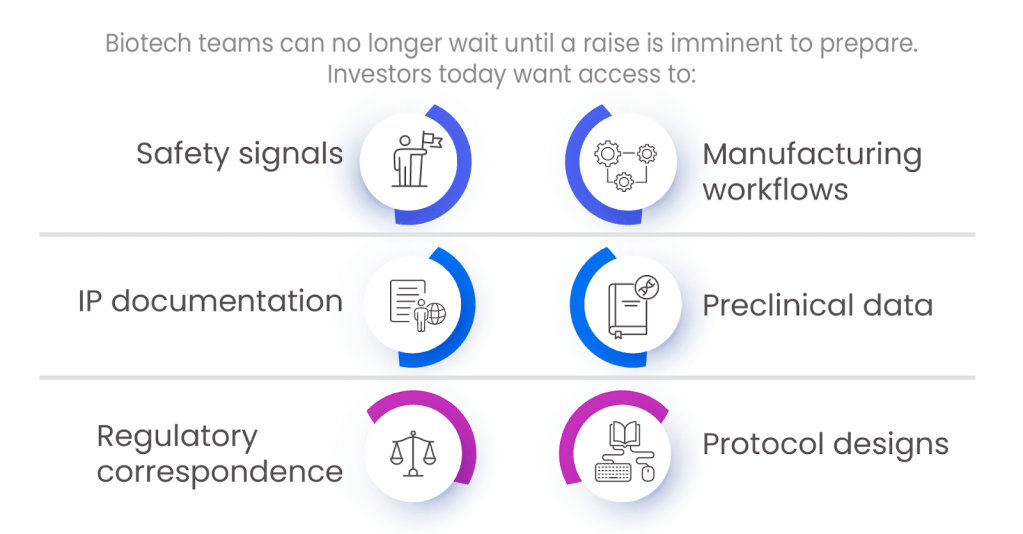
Biotech teams can no longer wait until a raise is imminent to prepare. Investors today want access to:
- Preclinical data
- Protocol designs
- Regulatory correspondence
- IP documentation
- Safety signals
- Manufacturing workflows
The companies that stand out aren’t just the ones with breakthrough science—they’re the ones that can demonstrate control of their data and clarity in their development story.
Why Investor Confidence Now Depends on Data Strategy
The new reality in life sciences is straightforward:
Investors don’t fund potential—they fund preparedness.
The industry is seeing a shift from pitch-driven fundraising toward data-driven diligence. Investors aren’t just asking for a deck. They want:
- Full study reports
- Version-controlled trial documents
- Transparent assumptions behind modeling
- Real-time visibility into new data
- Evidence of reproducibility
This increased scrutiny isn’t punitive—it’s the direct result of the capital cycles of the last five years. Investors today must differentiate science that’s “promising” from science that’s “provable.”
That requires more documentation, more clarity, and more rigor than ever.
And it’s not only venture investors. Pharma partners, licensing teams, and strategic collaborators have adopted a similar posture. They want more insight—and they want it earlier in the process.
The Rise of Always-On Transparency
The most forward-thinking biotech companies are adopting a model used by tech:
rolling, always-on diligence.
Instead of frantically assembling documents late in a process—or worse, during a term sheet negotiation—teams are building and maintaining structured, accessible, secure data environments months before they begin conversations.
The benefits are immediate:
✔ Faster fundraising cycles
Because documents are already organized, versioned, and validated.
✔ Smoother licensing and partnering discussions
Partners can review only what they need—no more endless back-and-forth file exchanges.
✔ Greater accuracy and compliance
Outdated PDFs, conflicting versions, and misplaced study data are eliminated.
✔ Trust is established earlier
Transparency is a signal of maturity and operational strength.
What’s emerging is a new expectation:
Diligence readiness is no longer a phase—it’s a posture.
Data Transparency as a Competitive Advantage in 2026
Life science teams that embrace data transparency gain advantages across the entire development and fundraising lifecycle:
1. Fundraising
VCs want lower-risk, cleaner, more detailed diligence packages. Teams that deliver this win faster investment.
2. Licensing & Partnering
Pharma partners are conducting deeper due diligence earlier, evaluating everything from preclinical reproducibility to IND-enabling documentation. A transparent, well-organized data room accelerates these conversations.
3. Scientific Collaboration
As more companies operate in distributed research environments—working with CROs, academic institutions, and co-development partners—secure collaboration tools become essential.
4. Regulatory Preparation
Regulators increasingly expect structured, traceable documentation. A robust data infrastructure reduces the likelihood of delays or rework.
5. IP Protection
Clear documentation trails and controlled access protect trade secrets, unpublished data, and proprietary methodologies.
In short:
The companies that are best organized will move the fastest. And the ones that move the fastest will win the deals.

How Modern Virtual Data Rooms Support This New Era
As transparency becomes essential, biotech teams are turning to modern virtual data rooms (VDRs) built for scientific and regulatory workflows—not just for M&A.
A purpose-built VDR helps life science teams:
✔ Maintain Version-Controlled Scientific Documentation
No more guessing which data cut is the latest.
✔ Collaborate Securely Across Multiple Stakeholders
CROs, consultants, advisors, and partners can be granted role-specific access.
✔ Protect Sensitive IP and Unpublished Data
Dynamic watermarking, view-only restrictions, and access logs ensure nothing gets downloaded or circulated unintentionally.
✔ Run Rolling or Staged Diligence Effortlessly
Investors see only what they should see—nothing more, nothing less.
✔ Track Engagement to Understand Investor or Partner Interest
Teams instantly know which protocols, datasets, or analyses are being viewed the most.
✔ Reduce the Operational Burden on Scientists and Executives
No more scrambling to assemble last-minute due diligence packages.
A modern VDR transforms diligence from a reactive scramble into a structured, proactive, strategic asset.
The Future Belongs to the Prepared
The 2026 funding environment isn’t easier—it’s smarter.
Investors are more selective. Partners are more data-driven. Science is moving faster, and documentation has never been more critical. But for companies that embrace transparency, clarity, and ongoing diligence readiness, the new landscape is not a barrier—it’s an opportunity.
The biotech teams that will win in 2026 are those that can say confidently:
- Our data is organized.
- Our documentation is reliable.
- Our story is clear.
- Our diligence is ready—anytime.
The companies that treat data transparency as a competitive differentiator will not only accelerate funding—they will accelerate science.