
In biotechnology, it is easy to believe that partnering begins when the data is ready.
A company reaches an important clinical milestone, presents promising results at a scientific conference, or begins preparing for a formal licensing process. Business development teams start scheduling meetings, investors make introductions, and conversations with pharmaceutical companies begin.
In reality, the strongest partnerships often begin years earlier.
Long before a term sheet is drafted or a confidentiality agreement is signed, companies are building reputations. They are establishing scientific credibility, demonstrating consistent execution, and developing relationships that quietly shape future opportunities.
By the time a formal partnering discussion takes place, much of the decision has already been influenced by what happened beforehand.
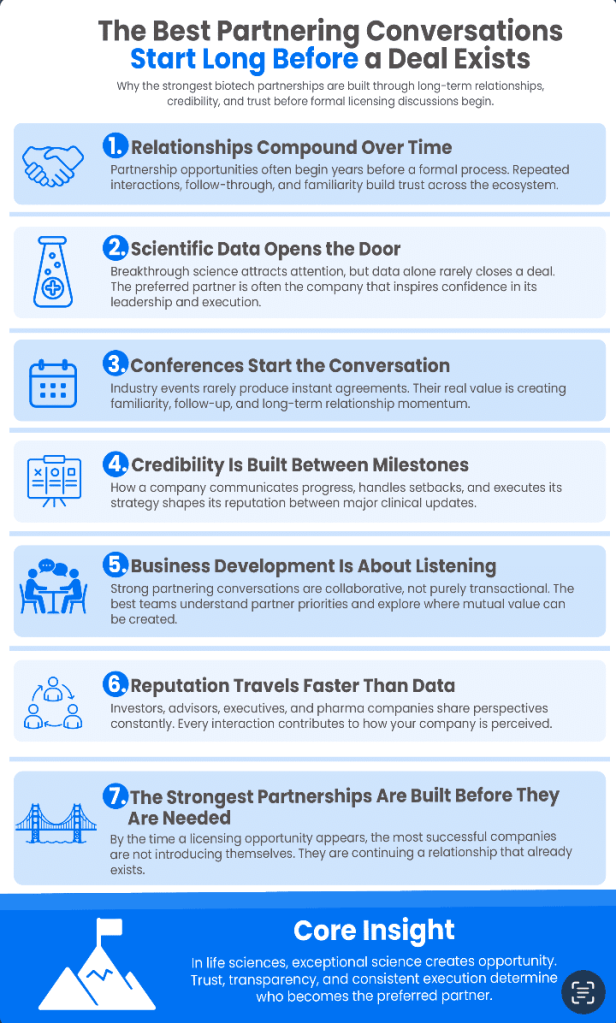
Relationships Compound Over Time
Business development is often viewed as a series of meetings.
Experienced life sciences leaders know it is a long term investment.
The executives who attend the same conferences year after year, contribute thoughtful perspectives to industry discussions, and consistently deliver on their commitments become familiar faces within the ecosystem. Investors introduce them with confidence. Advisors recommend them without hesitation. Pharmaceutical companies recognize their names before they walk into the room.
That familiarity matters.
Trust is rarely built during a single conversation. It develops through repeated interactions, consistent execution, and a reputation for doing what you say you will do.
Companies that invest in relationships long before they need a partner often find that opportunities arrive more naturally when the timing is right.
Scientific Data Opens the Door
Breakthrough science will always be the foundation of a successful biotechnology company.
Novel mechanisms, compelling clinical results, and differentiated platforms are what attract initial interest.
But scientific data alone rarely closes a partnership.
Large pharmaceutical companies are evaluating much more than the strength of an asset. They want to understand the people behind it. They assess how leadership responds to difficult questions, whether development plans are realistic, and whether management communicates with clarity and transparency.
Two companies may present equally promising science.
The company that inspires greater confidence often becomes the preferred partner.
Conferences Are the Beginning, Not the Finish
Major industry events generate thousands of meetings every year.
It is tempting to think those conversations are where partnerships are created.
More often, they are where relationships begin.
A productive conference meeting rarely ends with a signed agreement. Instead, it establishes familiarity and creates a reason to continue the conversation. Follow up discussions, scientific updates, milestone announcements, and informal check ins gradually strengthen the relationship over time.
The companies that approach conferences as opportunities to build long term credibility rather than secure immediate deals often see greater success.
Relationships grow through consistency, not urgency.
Credibility Is Built Between Milestones
Clinical milestones receive the headlines.
Everything that happens between those milestones shapes reputation.
How a company communicates progress, responds to setbacks, and engages with investors and potential partners tells an important story. Organizations that provide realistic updates, acknowledge challenges openly, and continue executing against their strategy demonstrate maturity that extends beyond the laboratory.
This type of credibility cannot be manufactured during a partnering process.
It is earned over time.
When pharmaceutical companies evaluate opportunities, they are not simply reviewing data packages. They are evaluating whether the organization has demonstrated the discipline required to navigate the uncertainty that defines drug development.
Business Development Is About Listening
Successful partnering is not simply about presenting a company’s science.
It is about understanding what potential partners are trying to accomplish.
Pharmaceutical companies have evolving pipeline priorities, therapeutic area strategies, manufacturing considerations, and commercial objectives. Business development leaders who spend time listening often identify opportunities that others overlook.
The strongest conversations feel collaborative rather than transactional.
Instead of focusing solely on why an asset is valuable, they explore how both organizations can create greater value together.
That shift in perspective often changes the quality of the relationship.
Reputation Travels Faster Than Data
The life sciences community is remarkably connected.
Investors speak with pharmaceutical companies. Scientific advisors serve on multiple boards. Executives move between organizations. Investment bankers, consultants, and attorneys often participate in dozens of transactions throughout their careers.
Reputation moves quickly through these networks.
Companies known for transparency, preparation, and professional execution frequently benefit from introductions and opportunities that never appear through formal outreach.
Likewise, organizations that develop a reputation for overpromising or poor communication may find that future conversations become more difficult before they even begin.
Every interaction contributes to that reputation.
The Strongest Partnerships Are Built Before They Are Needed
The companies that consistently secure high quality partnerships are rarely the ones that begin relationship building only after achieving a major milestone.
They understand that trust is cumulative.
Every conference conversation, investor update, scientific publication, advisory board meeting, and follow up discussion contributes to how future partners perceive the organization.
When a licensing opportunity finally emerges, those companies are not introducing themselves for the first time.
They are continuing a conversation that has already been developing for months or even years.
Final Thoughts
Life sciences partnerships are built on exceptional science, but they are sustained by trust.
Scientific innovation may create the opportunity, yet credibility, transparency, and consistent execution often determine which companies become preferred partners.
Organizations that invest in relationships before they need them place themselves in a stronger position when strategic opportunities arise. They enter partnering discussions with something far more valuable than a compelling presentation.
They enter with confidence that has already been earned.