For decades, the purpose of a virtual data room was relatively straightforward. Companies needed a secure place to share confidential information with buyers, investors, and advisors. The technology evolved, but the fundamental question remained the same: Who should have access to which documents?
That question is becoming more complicated.
As artificial intelligence transforms due diligence, private equity firms face growing pressure to exit aging investments, and regulators increase scrutiny of sensitive information, the role of the virtual data room is expanding well beyond traditional document sharing.
The next generation of dealmaking will involve more than buyers and sellers reviewing financial statements and contracts. AI systems will analyze documents, lenders will demand more detailed verification, limited partners will scrutinize investment decisions, and compliance teams will play a greater role in determining who can access sensitive information.
The result is a fundamental shift in how confidential information is managed throughout a transaction.
In 2027, the most important question may no longer be who can access the data room, but what they can do with the information once they enter.
A Changing M&A Market Is Creating New Demands
The M&A market entering 2027 presents an interesting contradiction. Transaction values have been recovering, but deal volume has not necessarily followed the same trajectory.
Research compiled for this article indicates that global M&A value in 2026 was on track to approach $4 trillion, approximately 13% higher than the previous year, while transaction volume was expected to decline by a similar percentage.
This suggests a market characterized by fewer transactions but larger commitments of capital.
At the same time, private equity firms are managing a substantial backlog of portfolio companies awaiting exits. EY has estimated that more than 32,000 private equity backed companies, representing approximately $4.1 trillion in value, remain in sponsor portfolios. Roughly 35% have been held for more than six years.
These conditions create competing pressures. Sellers need liquidity, while buyers are increasingly selective about where they deploy capital.
The implications for due diligence are significant.
Buyers have more reasons to examine financial performance, operational risks, regulatory exposure, and long term growth assumptions. Sellers, meanwhile, have greater incentives to prepare thoroughly and avoid delays that could undermine valuation.
This environment is likely to accelerate the adoption of technologies that make information easier to analyze, verify, and control.
AI May Become the First Reader in the Data Room
One of the most consequential changes in due diligence is the emergence of artificial intelligence as an active participant in the review process.
Traditionally, investment bankers, attorneys, accountants, and consultants spent considerable time reading documents, identifying inconsistencies, and compiling questions for management.
AI is beginning to automate portions of that work.
An Accenture survey of 650 dealmakers found that 46% of organizations were investing in generative AI for activities before a transaction, compared with 31% in 2024. McKinsey has also estimated that AI could reduce certain deal cycle times by 10% to 30% while lowering associated costs by approximately 20%.
These findings point toward a future in which AI assists with the initial examination of financial statements, contracts, corporate records, and other diligence materials.
Rather than manually reviewing hundreds of agreements to identify change of control provisions, a deal team may use AI to locate relevant clauses and flag potential concerns for legal review.
Financial advisors may use similar tools to identify inconsistencies between management projections, historical financial statements, and supporting documentation.
However, greater automation introduces an important question: How can organizations benefit from AI without losing control of confidential information?
Some sellers already restrict the use of public AI platforms during diligence, particularly when sensitive documents could be retained, processed, or used outside an approved environment.
This creates a compelling case for bringing AI capabilities into controlled collaboration environments where permissions, activity monitoring, and information governance can be maintained.
Human judgment will remain essential, particularly when interpreting complex legal, financial, and commercial issues. But AI may increasingly perform the first review, leaving professionals to validate findings and make decisions.
Private Equity Is Moving Toward Continuous Deal Readiness
Another important shift involves when companies begin preparing for a transaction.
Historically, many organizations assembled their due diligence materials only after deciding to pursue a sale. Financial documents were gathered, contracts were reviewed, and management teams worked with advisors to organize the information buyers would eventually request.
That approach is becoming less practical for private equity firms managing large portfolios and uncertain exit windows.
EY research indicates that 86% of general partners believe exit preparation improves valuations, with particularly strong outcomes when preparation begins 12 to 24 months before a transaction.
The implication is that readiness should become an ongoing operational discipline rather than a project initiated shortly before going to market.
For private equity sponsors, this could mean maintaining a continuously updated repository of financial information, contracts, operating metrics, governance records, and other diligence materials.
Such an environment might remain private until a transaction opportunity emerges, allowing the company to begin a formal process without spending months collecting information.
This approach could also support refinancing, minority investments, continuation vehicles, and other strategic transactions.
The broader shift is important. Instead of viewing the data room as a temporary tool opened for a specific deal, organizations may increasingly treat it as a permanent component of transaction readiness.
The Next Generation of Data Room Users May Not Be Buyers
The traditional data room was designed primarily around a buyer and seller relationship.
That model is expanding.
Private equity secondary transactions, continuation vehicles, and alternative financing arrangements are introducing new participants who need access to confidential information but are not necessarily bidding to acquire a company.
Evercore reported approximately $121 billion in secondary transaction volume during the first half of 2026, including roughly $65 billion in general partner led transactions.
These structures often require existing limited partners to evaluate whether they should sell their interests, reinvest, or participate in a continuation vehicle.
As a result, the data room becomes more than a transaction workspace. It becomes an important mechanism for investor transparency and governance.
Limited partners may need access to valuation materials, financial information, transaction terms, and supporting documentation to make informed decisions.
Lenders and insurers are also becoming more important participants in the information review process.
Private credit investors increasingly want access to detailed asset information rather than relying entirely on reports prepared by borrowers. Insurance underwriters may require additional documentation to evaluate transaction risks and determine appropriate coverage.
Each participant brings different information requirements, responsibilities, and access restrictions.
This points toward a future in which a single controlled information environment supports multiple audiences, each with a carefully defined view of the underlying information.

Life Sciences Transactions Are Becoming More Complex
The life sciences industry illustrates how scientific innovation, international partnerships, and regulatory requirements are changing due diligence.
Pharmaceutical companies face substantial revenue exposure from upcoming patent expirations. Analysis from PwC and GlobalData suggests that more than $300 billion in branded pharmaceutical revenue could face patent expiry by 2030.
This creates incentives for pharmaceutical companies to acquire, license, and partner with biotechnology companies developing promising therapies.
At the same time, cross border licensing activity has expanded, particularly involving Chinese biotechnology companies.
Research cited in the underlying analysis identified a record 157 Chinese out licensing transactions worth approximately $135.7 billion in 2025, with activity in 2026 surpassing that annual record by early October.
These transactions introduce increasingly complicated questions about intellectual property, clinical data, patient privacy, regulatory requirements, and international information access.
In the United States, rules governing access to certain categories of sensitive personal data by countries of concern have added another layer of scrutiny.
For example, the Department of Justice’s Data Security Program imposes restrictions on certain transactions involving bulk sensitive personal data, including human genomic information. Some regulatory exceptions apply, but organizations must still evaluate whether particular data transfers and access arrangements are permitted.
For life sciences companies, this means access controls may need to account for more than an individual’s role in a transaction.
The identity, ownership structure, and geographic connections of an organization requesting information may also become relevant.
As international biotechnology partnerships expand, the ability to control precisely what information is shared, with whom, and under what conditions will become increasingly important.
AI Due Diligence Is Becoming a New Category of Risk
Artificial intelligence is not only changing how buyers conduct due diligence. It is also changing what buyers need to investigate.
A company does not need to develop AI products to have meaningful AI exposure.
Businesses across healthcare, financial services, manufacturing, technology, and professional services are incorporating AI into internal operations, customer experiences, analytics, and decision making.
These activities can introduce legal, operational, intellectual property, and cybersecurity risks that traditional diligence processes may not fully capture.
Buyers are increasingly interested in understanding which AI systems a target uses, how those systems were developed, what data supports them, and whether appropriate governance policies exist.
Potential diligence questions include:
- What AI systems are currently used across the organization?
- Were training datasets obtained and licensed appropriately?
- What agreements govern third party AI providers?
- How is confidential customer information protected?
- What policies govern employee use of generative AI?
- Has the company experienced AI related security or compliance incidents?
- Can management document the origins of important datasets and models?
These questions are especially relevant for companies whose valuation depends heavily on proprietary technology, intellectual property, or data assets.
European AI regulation adds another consideration. Certain high risk AI obligations are scheduled to apply in December 2027, creating additional reasons for organizations to assess their documentation and compliance readiness.
For deal teams, AI governance may become a standard diligence category alongside cybersecurity, intellectual property, financial controls, and regulatory compliance.
The Q&A Process May Become More Important Than Ever
As AI makes document analysis faster, the number and complexity of diligence questions may increase.
A buyer that previously reviewed a sample of contracts may soon be able to analyze an entire contract library and identify discrepancies across hundreds of agreements.
This creates opportunities for more thorough diligence, but it also introduces operational challenges for sellers.
Management teams may face larger volumes of highly specific questions, many generated or assisted by AI.
Responding quickly will matter, but accuracy will matter more.
AI generated responses can contain errors, omit important context, or present conclusions with more confidence than the supporting evidence justifies.
In a transaction, those mistakes can have serious consequences.
Inaccurate diligence responses may influence valuation, negotiations, contractual representations, or insurance coverage.
The strongest deal processes will therefore need more disciplined systems for managing questions and answers.
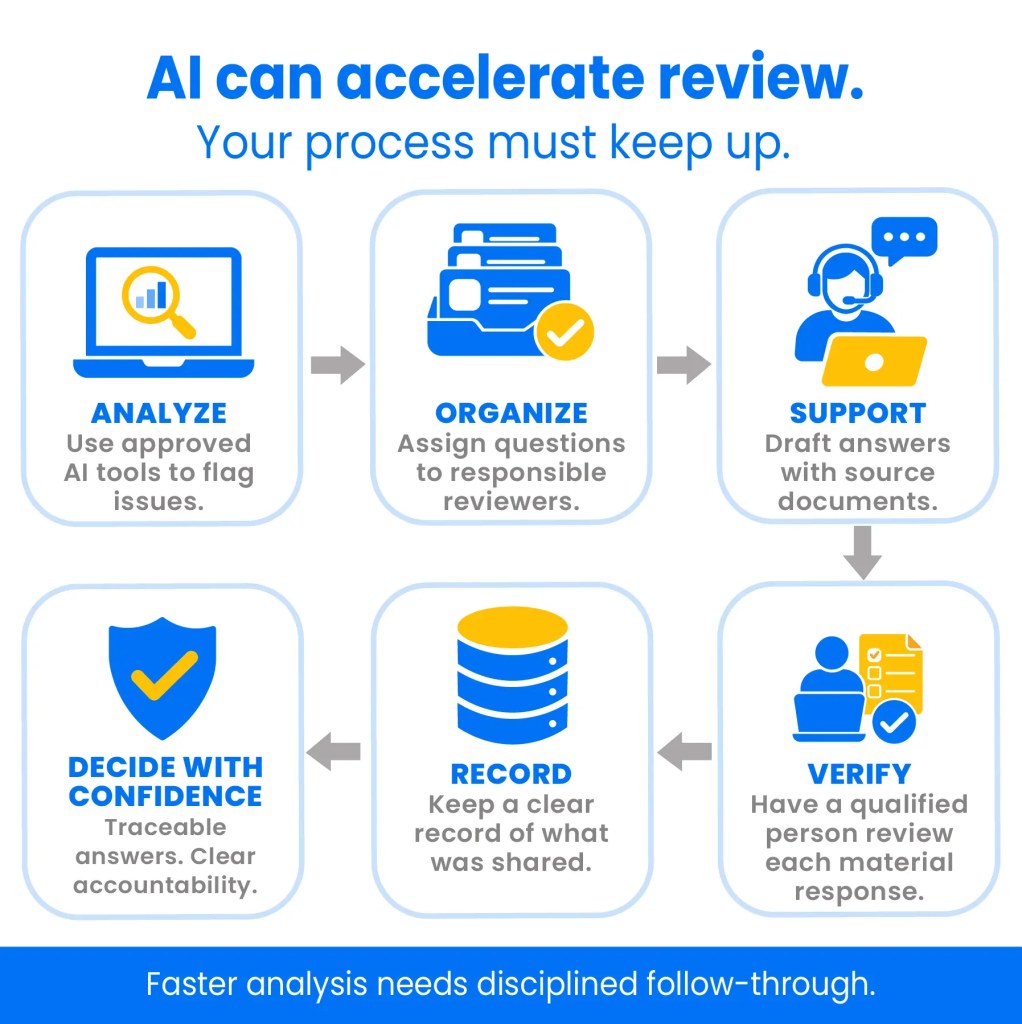
Every material response should have a responsible human reviewer, a supporting source, and a clear record of what information was provided.
AI may help prepare answers, but accountability must remain with the people responsible for the transaction.
Faster Analysis Does Not Necessarily Mean Faster Closings
One of the most common predictions about AI in M&A is that it will dramatically shorten transaction timelines.
That outcome is possible, but it is not guaranteed.
While AI can reduce the time required to review documents, it can also make deeper analysis economically practical.
Buyers may use the time saved on routine reviews to investigate additional risks involving cybersecurity, AI governance, data privacy, supply chain dependencies, and regulatory exposure.
As a result, diligence may become more comprehensive without becoming significantly shorter.
This distinction matters.
The real benefit of AI may not be the ability to close every transaction faster. It may be the ability to make better informed decisions with fewer overlooked issues.
For sellers, the challenge will be ensuring that greater analytical capabilities do not create an endless cycle of additional questions and delays.
Preparation, disciplined communication, and well organized information will remain critical to maintaining momentum.
Security Will Need to Evolve With AI
As AI becomes more deeply integrated into confidential collaboration, security requirements will also change.
Traditional virtual data room controls focus on who can view, print, download, or distribute a document.
AI introduces new activities that may require additional oversight.
Can an AI assistant summarize a confidential agreement? Can it compare documents across folders? Can extracted information be transferred to another application? Can a model retain information after a user loses access?
These are not simply technical questions. They involve confidentiality obligations, contractual restrictions, and information governance.
Organizations may increasingly require AI specific permissions that determine which tools can process confidential information and what those tools are allowed to do with it.
The growing use of AI also introduces new security concerns, including attempts to manipulate automated systems through malicious content embedded in documents.
As these capabilities mature, security teams will need to consider both human access and machine access when designing information protection policies.
The objective will remain familiar: allow authorized participants to work efficiently while preventing confidential information from being exposed or misused.
The methods required to achieve that objective, however, are evolving.
Five Ways Deal Teams Can Prepare for 2027
The changes underway do not require organizations to abandon established due diligence practices. They require those practices to evolve.
1. Review information before buyers do. Companies should identify inconsistencies across financial records, contracts, operating metrics, and management presentations before beginning a transaction. AI assisted analysis may help uncover issues that would otherwise emerge during buyer diligence.
2. Establish clear rules for AI use. Confidentiality agreements and diligence procedures should address whether participants may use AI tools, which systems are permitted, and how sensitive information must be protected.
3. Make deal readiness continuous. Rather than waiting for a sale process to begin, organizations should maintain current financial, legal, operational, and compliance documentation throughout the year.
4. Expand diligence preparation to include AI and data governance. Companies should document their AI systems, important datasets, vendor relationships, security policies, and relevant regulatory obligations before buyers request that information.
5. Strengthen accountability in the Q&A process. Every significant response should be reviewed by an appropriate professional and supported by reliable documentation. Speed should never come at the expense of accuracy.
These steps can help organizations prepare for a more demanding transaction environment while reducing unnecessary uncertainty for buyers, investors, and advisors.
The Future of the Data Room Is Bigger Than the Deal
Virtual data rooms were originally designed to solve a specific problem: securely sharing confidential documents during a transaction.
That problem has not disappeared, but the environment surrounding it has become far more complex.
AI is changing how information is analyzed. Private equity firms are moving toward continuous exit readiness. Limited partners, lenders, and insurers are demanding greater transparency. Life sciences transactions are introducing new challenges involving sensitive data and international access. Buyers are expanding diligence to include risks that barely existed a few years ago.
Together, these developments suggest that the next generation of virtual data rooms will play a broader role in the transaction lifecycle.
They will need to support not only secure document sharing, but also intelligent analysis, information governance, collaboration, and accountability across increasingly diverse groups of participants.
For investment bankers, private equity firms, corporate development teams, and life sciences organizations, the opportunity is to prepare for that transition now.
The future of due diligence will not be defined solely by how quickly information can be accessed.
It will be defined by how confidently that information can be understood, verified, and used to make decisions.
And in 2027, some of the most important participants in that process may not be human.