Artificial intelligence has become the biggest boardroom conversation of the past two years.
Companies are investing millions in new AI tools, automating workflows, and racing to stay ahead of competitors. Yet despite the excitement, the vast majority of organizations are seeing little or no measurable return.
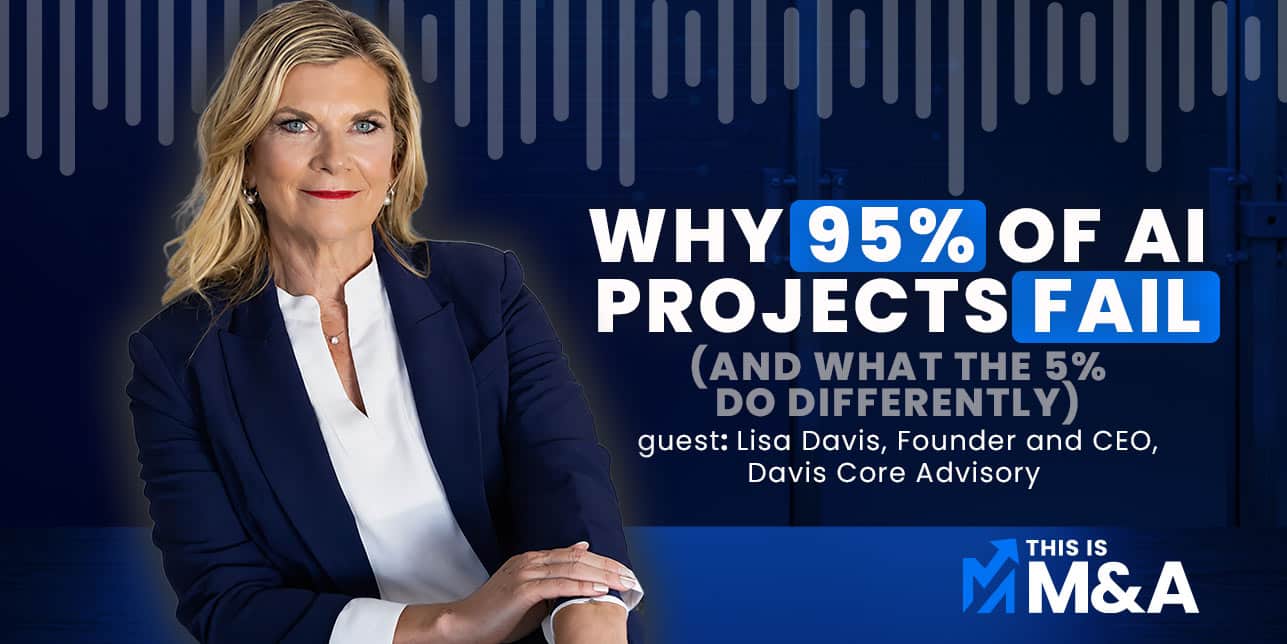
According to Lisa Davis, Founder and CEO of Davis Core Advisory and a CIO Hall of Fame inductee, 95% of enterprises show no ROI from their AI investments. The problem isn’t the technology. It’s the organization behind it.
In the latest episode of This Is M&A, Lisa joins Steven Monterroso to explain why AI initiatives fail, what leaders consistently overlook during digital transformation, and why these same issues determine whether companies are prepared for growth, acquisitions, and long term success.
The Technology Is Not the Problem
When AI projects stall, most organizations assume they chose the wrong platform.
Lisa argues they’re asking the wrong question.
Technology alone does not create transformation.
Successful AI adoption depends on three things:
- Reliable data
- Well defined business processes
- Organizational readiness
Companies often purchase AI software before addressing any of these foundational issues. The result is predictable. Expensive technology simply accelerates existing inefficiencies.
Digital transformation has never been about software alone. It is fundamentally about leadership, communication, and execution.
Crappy Data In, Crappy Data Out
One of Lisa’s simplest observations may also be the most important.
If your data is disorganized, incomplete, or inaccurate, AI cannot fix it.
It only amplifies the problem.
Many organizations don’t even know where all of their data lives. Information sits across departments, disconnected systems, spreadsheets, and legacy applications. Before executives can expect meaningful AI outcomes, they need confidence that their underlying data is accurate, accessible, and trustworthy.
The lesson extends beyond artificial intelligence.
Whether you’re implementing new technology, preparing for due diligence, or integrating an acquired company, organized information is a competitive advantage.
Clean data leads to better decisions.
Messy data creates unnecessary risk.
People and Process Drive Every Transformation
Technology projects often fail because leadership treats them as IT initiatives.
Lisa believes that mindset misses the bigger picture.
Transformation succeeds when people understand why change is happening, how it benefits them, and what success looks like.
That requires far more communication than most executives realize.
Leaders cannot announce a new initiative once and assume everyone is aligned. They must consistently reinforce the vision, explain progress, answer concerns, and keep teams engaged throughout the process.
Without that communication, uncertainty grows.
Without alignment, even the best technology struggles to deliver value.
Build Momentum Before You Expect Results
Large transformation initiatives rarely succeed through one massive rollout.
Lisa describes successful organizations as building a flywheel.
Instead of chasing one dramatic breakthrough, they create momentum through a series of smaller wins that reinforce one another. Each success builds confidence, encourages adoption, and creates organizational energy for the next phase.
The same principle applies to mergers and acquisitions.
Companies that consistently improve processes before an acquisition are far better positioned to execute after the deal closes.
Transformation is not an event.
It is a discipline.
Why Boardrooms Need Technology Leaders
Modern organizations rely on technology more than ever before.
Yet many corporate boards remain dominated by CEOs, CFOs, and traditional operating executives.
Lisa believes that creates a growing gap.
Artificial intelligence, cybersecurity, data governance, and digital infrastructure have become strategic business issues, not technical ones. Boards need leaders who understand these risks and opportunities firsthand.
As companies continue investing in AI, technology leadership will become increasingly valuable at the board level. Organizations that diversify board expertise will be better equipped to govern future growth and transformation.
Your Next Career Shouldn’t Be an Afterthought
The conversation also explores what Lisa calls a portfolio career.
Rather than viewing retirement as a finish line, she encourages executives to intentionally design the next stage of their careers long before they need it.
Serving on boards, advising companies, mentoring founders, investing, or consulting all require years of relationship building.
Lisa notes that roughly 80% of board opportunities come through your professional network, making long term planning essential for executives who want to continue making an impact after leaving full time operating roles.
Companies Worth Buying Are Built Before the Deal
One of the strongest themes throughout the episode is that organizational readiness matters far beyond AI.
Companies with clean data, disciplined leadership, effective communication, and repeatable processes are not only more successful during transformation.
They are also more attractive acquisition targets.
Acquirers evaluate far more than financial statements. They assess whether a business can execute, adapt, and scale after the transaction closes.
Organizations that have already built those capabilities reduce risk and create greater long term value.
Listen to the Full Episode
Lisa Davis has spent more than three decades leading digital transformation across government, healthcare, higher education, and enterprise technology. Her perspective offers practical guidance for executives navigating AI adoption, organizational change, and leadership in an increasingly digital world.
Whether you’re leading an AI initiative, preparing your company for growth, or thinking about your own leadership journey, this episode delivers valuable lessons that extend well beyond technology.
Ready to try ShareVault for your next deal?