Most founders spend years building a company and only a few months preparing to sell it.
That imbalance costs them.
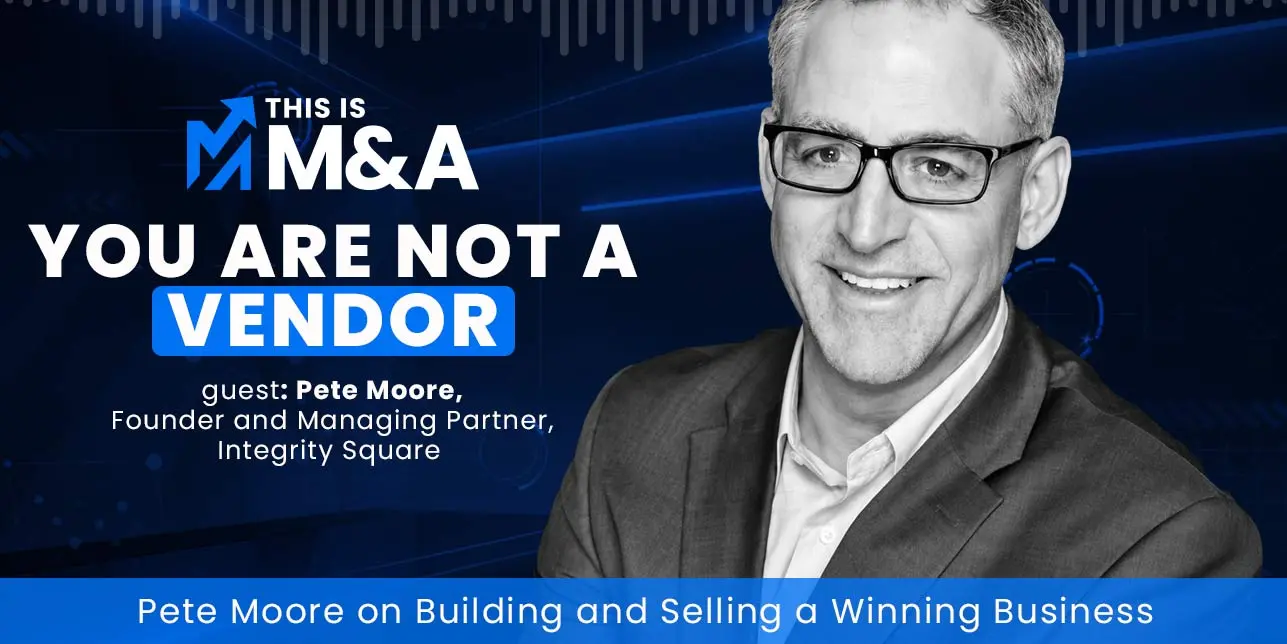
In the latest episode of This Is M&A, Steven Monterroso sits down with Pete Moore, Founder and Managing Partner of Integrity Square, to discuss what separates companies that attract premium valuations from those that leave money on the table. After more than two decades advising founders and completing over $1.5 billion in transactions, Pete has developed a simple philosophy: successful exits are not created during the sale process. They are earned years before it begins.
His message is direct, practical, and occasionally uncomfortable.
If you’re planning to sell your business someday, this conversation is your playbook.
Every Business Solves a Frustration
Pete believes most business strategy can be simplified into one question:
What frustration are you solving, and who is willing to pay for it?
Too many founders become obsessed with products, features, and technology while losing sight of the underlying problem their customers need solved. Buyers, investors, and acquirers ultimately care about one thing: whether your company has built a repeatable solution that customers consistently value.
If you cannot clearly explain the frustration you eliminate and why customers choose you over alternatives, your business story becomes difficult to sell.
The strongest companies understand their market, understand their customers, and communicate their value proposition with absolute clarity.
Revenue Is Only Two Things
Pete offers another deceptively simple framework:
Revenue has only two levers.
You either:
- Sell more units.
- Increase price per unit.
Everything else is execution.
While founders often chase complexity, successful operators focus on improving one of these two variables. Whether you’re scaling a fitness company, software platform, healthcare business, or manufacturing operation, sustainable growth comes from increasing volume, increasing value, or both.
For buyers evaluating an acquisition target, this clarity matters.
Businesses with predictable growth engines are easier to understand, easier to model, and ultimately easier to acquire.
You Cannot Microwave a Manager
One of the most memorable moments of the episode centers on leadership development.
Pete argues that great leaders are not created overnight.
His analogy:
You can microwave dinner. You cannot microwave a manager.
Strong management teams are developed slowly through trust, coaching, accountability, and experience. The companies that command premium valuations typically have leadership depth that extends beyond the founder.
This matters because acquirers are not just buying financial performance.
They are buying confidence in the future.
When buyers see a business that depends entirely on one founder, risk increases. When they see capable leaders throughout the organization, confidence rises.
Pete also emphasizes transparency. Sharing financial information and helping key employees understand how the business operates creates stronger alignment and greater ownership throughout the organization.
The result is a company that can thrive before, during, and after a transaction.
The Fourth Quarter Nobody Warns You About
Many founders believe the hard work is over once a Letter of Intent is signed.
In reality, that is when the pressure often begins.
Pete describes this stage as the fourth quarter of the transaction.
The diligence process intensifies. Questions multiply. Uncertainty spreads throughout the organization. Employees begin hearing rumors. Competitors look for opportunities. Buyers scrutinize every detail.
This is where deals frequently encounter problems.
Founders who fail to communicate effectively with key employees can lose valuable talent at exactly the wrong moment. Retention concerns, uncertainty, and poor messaging can create distractions that jeopardize transaction momentum.
According to Pete, successful founders prepare for this stage long before it arrives.
They identify critical personnel, develop retention strategies, control the narrative, and ensure the organization remains focused while the deal moves toward closing.
Silence Is the Death Knell
One of Pete’s strongest warnings centers around communication.
During an acquisition process, people naturally fill information gaps with assumptions.
When founders stop communicating, employees become anxious. When advisors go silent, clients become nervous. When buyers disappear, sellers begin questioning commitment.
Silence creates uncertainty.
Uncertainty creates risk.
The most effective dealmakers understand that communication is not merely a courtesy. It is a critical component of transaction management.
Even when there is little new information to share, maintaining consistent communication helps preserve trust and keeps stakeholders aligned.
Why Your Advisor Is Not a Vendor
The statement that became the centerpiece of the episode came when Pete challenged how some founders view their M&A advisors.
His position is simple:
An M&A advisor is not a vendor.
A vendor provides a service.
An advisor helps shape the outcome.
When founders treat their investment banker, advisor, attorney, or transaction team like a commodity, they often underestimate the strategic role those professionals play.
Selling a company is one of the most consequential financial events in an entrepreneur’s life. The advisor’s job extends far beyond preparing documents or coordinating meetings.
They manage process. Control momentum. Create competitive tension. Navigate obstacles. Guide negotiations. Protect value.
Pete compares the role to an offensive coordinator during the playoffs.
The stakes are high. The pressure is intense. Every decision matters.
Founders who recognize this reality are often better prepared for the challenges that come with a sale process.
Building a Business Worth Buying
One theme appears throughout the entire conversation.
Great exits rarely happen by accident.
The businesses that attract serious buyers are usually built with intention years before they enter the market. They solve meaningful customer problems. They have clear growth engines. They develop strong leadership teams. They communicate effectively. They prepare for diligence before diligence begins.
In other words, they become businesses worth buying long before anyone decides to buy them.
That preparation creates options.
And options create value.
Listen to the Full Episode
Pete Moore has spent more than 20 years helping founders navigate growth, leadership, and exits. His insights offer a practical roadmap for entrepreneurs who want to build stronger companies and achieve better outcomes when it’s time to sell.
If you’re a founder, business owner, investor, or advisor, this is an episode worth adding to your playlist.
Listen to This Is M&A and discover what it really takes to build a business worth buying.